
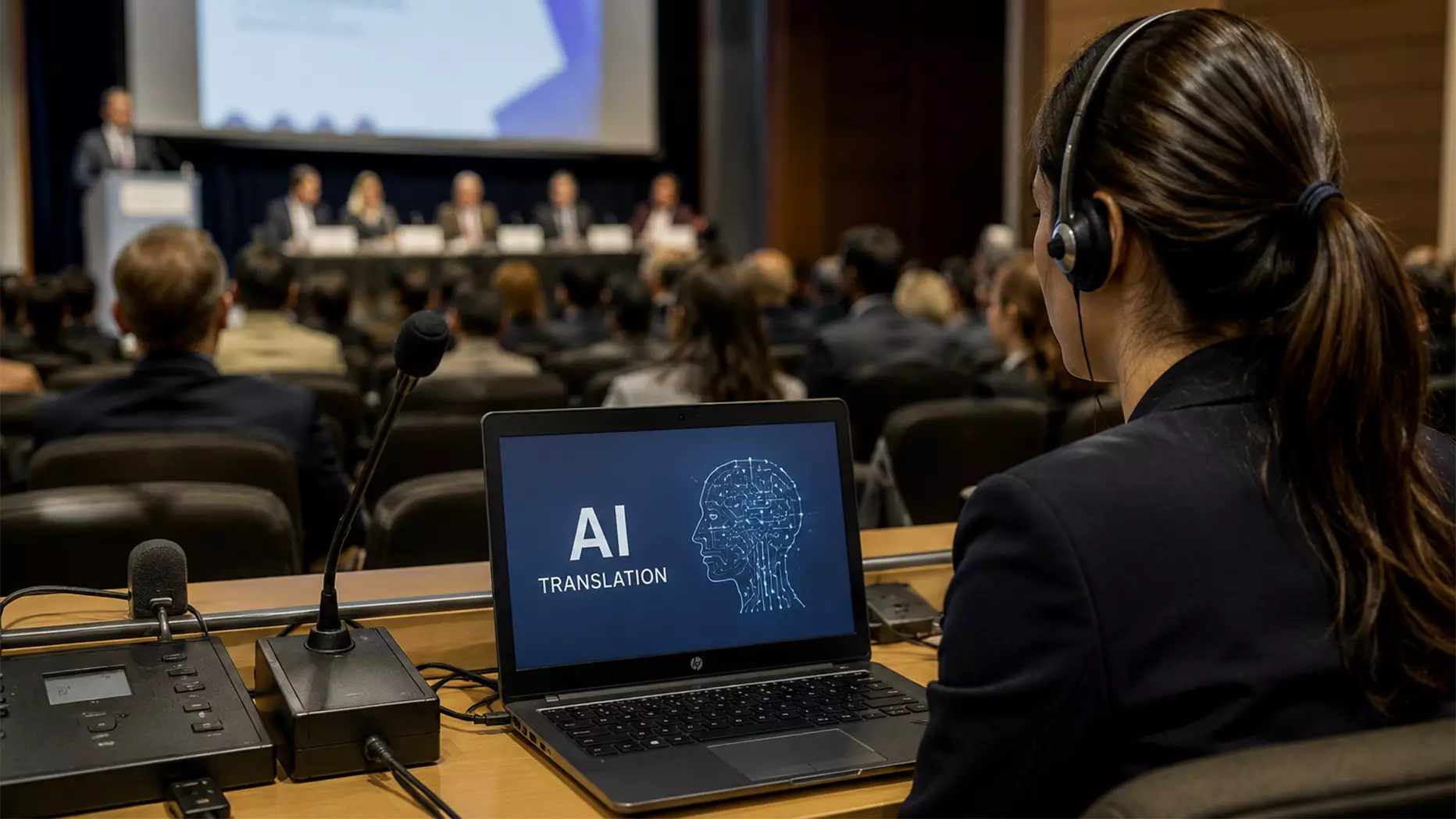
Can a computer really catch what people mean, not just what they say? It’s a question every global event now faces. AI interpreters are becoming faster and smarter, helping people communicate across languages in real time. But speaking another language is not just about words. It’s about emotion, timing, and respect for culture.
As meetings get more digital, one thing stays clear: technology helps, but it can’t replace a human touch. Let’s look at how AI interpreters fit into modern conferences, and why human interpreters still lead the way.
What Are AI Interpreters And How Do They Work?
AI interpreters translate speech instantly using voice recognition and machine learning, but they can’t understand emotion or intent.
An AI interpreter uses smart software to listen, translate, and speak in another language within seconds. They work in three steps: they hear speech, turn it into text, and then speak the new language out loud. This is fast, but it’s also limited. A system can translate the words, but not the feeling. It can repeat, “thank you,” but it won’t catch the sarcasm, humour, or tone.
The Rise Of AI In Modern Conferences
AI tools now make multilingual meetings faster and cheaper, but not always accurate or human-like. At global events, AI interpreters are showing up everywhere. They power live captions, instant app translations, and headsets that switch languages on demand. This kind of conference technology saves time and cost. But when the topic gets complex, like law, medicine, or business strategy, AI starts to struggle. It may miss cultural cues, mix up tone, or misread emotion. For big meetings, accuracy still depends on people, not programs.
Where AI Interpreters Still Fall Short
AI struggles with cultural meaning, humour, and empathy, areas where humans shine.
AI translation tools work great for short, simple phrases. But they often miss the deeper layers of speech. Think of a speaker saying, “That deal was a slam dunk.” The machine might translate it. A human interpreter knows it means success.
AI does not understand humour, irony, or sensitivity. It can’t lead the room or sense when someone is emotional. At times, it even misinterprets important details because it focuses on words instead of context. Until AI learns to feel, it won’t truly interpret.
Why Human Interpreters Remain Irreplaceable
Human interpreters bring trust, judgement and emotion that no machine can match. Human interpreters don’t just translate, they connect. They sense when a word might offend, when a speaker is nervous, or when a joke should be softened. They make sure every message sounds right in both meaning and mood.
They also protect privacy and handle sensitive conversations that AI systems should not record or store. At EMS Communications, we have seen how real people and smart tools work best together. Our simultaneous interpretation systems help interpreters perform with clarity, not compete with technology.
The Hybrid Future: AI + Human Collaboration
The strongest approach combines AI’s speed with human judgement and care. The future is not about replacing people; it’s about helping them. AI interpreters can support professionals by handling prep work, showing live captions, or helping with complex terminology. Then the human interpreters add what machines lack: heart, humour, and human sense.
At EMS Communications, we design conference AV integration that makes this partnership smooth. AI handles the routine; humans deliver the message.
AI Vs Human Interpreters: A Quick Comparison
| Criteria | AI Interpreters | Human Interpreters |
| Speed | Instant response | Slight delay, natural rhythm |
| Context | Limited understanding | Full cultural awareness |
| Tone | Robotic and flat | Warm, emotional, expressive |
| Accuracy | Strong for short phrases | Best for complex dialogue |
| Confidentiality | Risk of data storage | 100% human discretion |
| Adaptability | Struggles with slang or idioms | Adjusts instantly |
| Best Use | Captions, simple meetings | Conferences, diplomacy, events |
End-To-End Interpretation Technology Solutions
EMS Communications blends Bosch technology with decades of experience to empower human interpreters, not replace them. With over 25 years in the field, EMS Communications has supported global events with expert interpreting technology and trusted human teams. Using Bosch Integrus systems, we give interpreters crystal-clear sound and reliable tools so they can focus fully on performance. We provide:
- Full conference audio setup and AV integration.
- Soundproof interpreter booths.
- Wireless headsets and microphones.
- 24/7 technical support before and during events.
We don’t see AI as competition; it’s collaboration. Every word still needs a human ear to make sense.
The Real Role Of Technology In Interpretation
Technology should support interpreters, not replace them. AI in multilingual events plays an important part: it reduces workload, improves preparation, and offers real-time assistance. But communication will always be human at its core.
At EMS Communications, we use Bosch interpretation systems and advanced simultaneous interpretation systems to help interpreters perform at their best. Our goal is clear, sound, steady performance, and seamless connection between every voice in every language.
Interpretation Will Always Need Humans
AI makes interpretation faster, but humans make it meaningful.
Technology is changing the way we work, but it can’t replace empathy or trust. AI interpreters will continue to support and simplify, but the art of live communication, the moment where emotion meets understanding, still belongs to people.
When you plan your next global event, trust EMS Communications to blend human skill and smart technology. Our Audio-Visual Solutions and Simultaneous Interpretation Services ensure your message travels the world without losing its meaning.
FAQs
Can AI Interpreters Replace Human Interpreters?
Not yet. AI can’t match human understanding, emotion, or flexibility.
How Accurate Are AI Translation Tools?
They’re fine for short texts but fail with humour, culture, or tone.
Why Do Conferences Still Hire Human Interpreters?
Because they ensure accuracy, empathy, and a real human connection.
How Does EMS Communications Use Technology?
We use Bosch systems and conference AV integration to help interpreters deliver better sound and focus.
What’s Next For AI In Interpretation?
A partnership, AI assists, humans interpret. Together, they make communication faster and stronger.