
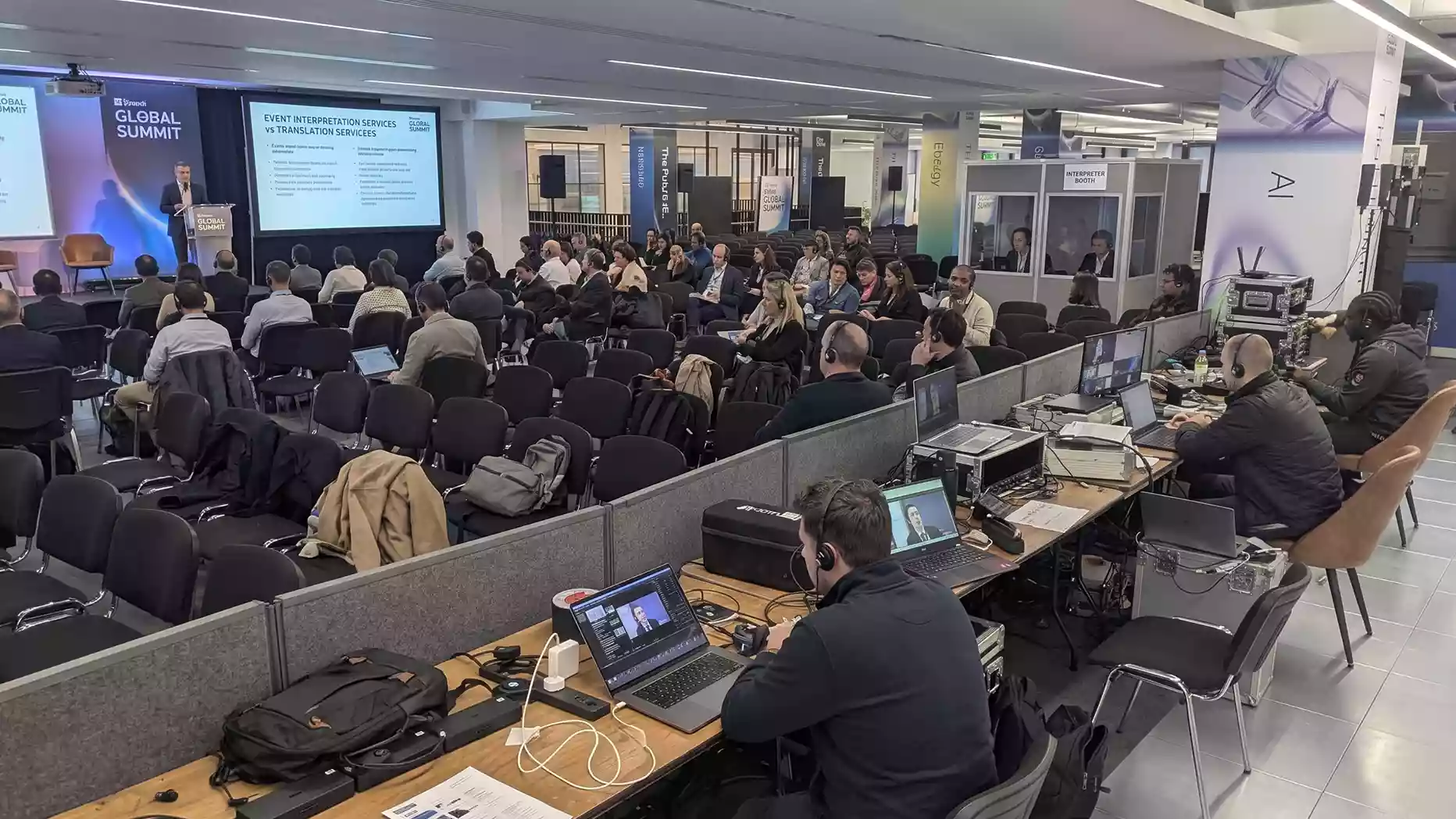
Translation and interpretation are often treated as the same thing.
They are not.
That mistake can create real problems when an event is live. A delegate is listening through a headset. A speaker is answering questions. A panel is moving quickly. A remote attendee is waiting for the next point. There is no time to stop, rewrite or polish the message.
That is where event interpretation services matter.
Translation is usually for written content. Interpretation is for spoken communication. One protects the accuracy of documents. The other protects the flow of live conversation.
If you are planning a multilingual conference, AGM, product launch, panel discussion or hybrid event, choosing the wrong service can affect timing, clarity and audience trust. This guide explains the difference, when to use each service, and how to plan language support properly.
What Are Event Interpretation Services?
Event interpretation services convert spoken language into another spoken language during a live event, so attendees can understand the speaker in real time or near real time.
They are used when people need to listen, respond, ask questions or follow a discussion as it happens. This can include conferences, business meetings, legal events, medical forums, international summits, product launches, exhibitions and hybrid events.
| Feature | Event Interpretation Services | Translation Services |
| Main format | Spoken language | Written text |
| Timing | Live or near-live | Before or after communication |
| Used for | Conferences, meetings, panels, Q&A | Documents, reports, websites, brochures |
| Main skill | Listening, memory, speech delivery | Writing, editing and research |
| Equipment needed | Booths, consoles, microphones, headsets | Translation tools, style guides, files |
| Event impact | Keeps live communication moving | Supports written communication |
| Best result | Attendees understand in real time | Readers receive accurate written content |
The European Commission explains the difference clearly: interpreters work with spoken words, while translators deal with written texts. That is the simplest way to separate the two.
For event planners, the difference matters because live language support has to work in the room, through the sound system and sometimes through an online platform. EMS Communications supports this with interpretation equipment hire, professional interpreters and technical support for multilingual events.
What Are Translation Services?
Translation services convert written content from one language into another, usually before or after an event.
They are useful when your audience needs accurate written material. This may include agendas, invitations, safety information, contracts, speaker notes, exhibition brochures, product sheets, legal documents, websites, press releases, subtitles or post-event reports.
A translator has time to read, research, edit and revise. That is very different from an interpreter, who has to process spoken language live.
Translation services are best for:
- Delegate handbooks.
- Legal or commercial documents.
- Website pages and landing pages.
- Marketing brochures.
- Speaker biographies.
- Training manuals.
- Subtitles and captions for recorded content.
- Post-event reports.
- Follow-up emails and resources.
ISO 17100 is the international standard for translation services. It sets requirements for the core processes, resources and other parts needed to deliver quality translation work. However, ISO states that this standard does not apply to interpreting services.
That is why written translation and live interpretation should not be planned as one generic “language service”. They solve different problems.
How Are Interpretation and Translation Different at Events?
Interpretation supports live speech, while translation supports written content before, during or after the event.
This difference affects the team, timeline, tools and risk level. A translator may work days or weeks before the event. An interpreter works while the speaker is talking. A translation can be checked and revised. A live interpretation must be accurate in the moment.
| Event Need | Choose Interpretation | Choose Translation |
| A keynote needs to be understood live | Yes | No |
| A contract needs to be provided in another language | No | Yes |
| A Q&A needs multilingual support | Yes | No |
| A brochure needs foreign-language copy | No | Yes |
| A panel discussion needs real-time access | Yes | No |
| A recorded video needs subtitles | Sometimes | Yes |
| A hybrid event needs remote language access | Yes | Sometimes |
| Speaker notes need to be provided in another written language | No | Yes, before the event |
The two services can also work together. For example, translated speaker notes can help interpreters prepare. Translated slides can support delegates. A translated post-event report can help international stakeholders after the event.
But during the live session, event interpretation is what keeps multilingual communication moving.
What Types of Interpretation Are Used at Events?
The main types of event interpretation are simultaneous interpretation, consecutive interpretation and remote simultaneous interpretation.
Each works differently, so the right choice depends on your event format.
- Simultaneous Interpretation
Simultaneous interpretation happens while the speaker is talking. The interpreter listens and delivers the message in another language almost at the same time. Delegates usually listen through headsets or receivers.
This is ideal for conferences, international panels, AGMs, product launches and large meetings where pauses would interrupt the event flow.
- Consecutive Interpretation
Consecutive interpretation happens when the speaker pauses and the interpreter then delivers the message in the target language. It is often used for smaller meetings, interviews, formal visits or short speeches.
It needs less equipment, but it takes longer because the speaker and interpreter take turns.
- Remote Simultaneous Interpretation
Remote simultaneous interpretation allows interpreters to work through a secure online platform. It can support hybrid or virtual events, especially when interpreters, speakers and audiences are in different places.
Remote formats still need strong audio, clear speaker discipline and technical testing. For more details, read our guide on how technology is changing interpreting services.
When Should Event Planners Use Interpretation Instead of Translation?
Event planners should use interpretation when people need to understand spoken content as it happens.
If the communication is live, interactive or time-sensitive, translation alone will not solve the problem. A translated agenda will not help a delegate follow a live keynote. A translated brochure will not help during a fast Q&A. A translated script will not support an unscripted panel discussion.
Use event interpretation services for:
- Live speeches.
- Conference keynotes.
- Panel discussions.
- Audience Q&A.
- International meetings.
- Legal or medical discussions.
- Diplomatic or government events.
- Hybrid events with remote guests.
- Training sessions with live questions.
- Product launches for multilingual audiences.
Use translation services for:
- Written agendas.
- Delegate materials.
- Contracts and terms.
- Marketing copy.
- Websites and landing pages.
- Brochures and product sheets.
- Subtitles for edited recordings.
- Post-event documents.
A simple rule helps: if people need to hear and respond now, choose interpretation. If people need to read and review, choose translation.
Why Does Equipment Matter for Event Interpretation Services?
Equipment matters because interpreters can only interpret accurately when they can hear clearly and their interpretation can be delivered clearly to the audience.
Even the best interpreter will struggle with poor audio. If the speaker’s microphone is unclear, the interpreter misses the detail. If there is an echo, delay or background noise, the interpreter has to work harder. If delegates receive weak sound through headsets, the audience experience suffers.
A professional setup may include:
- Interpreter booths.
- Interpreter consoles.
- Speaker microphones.
- Audio feeds.
- Headsets or receivers for delegates.
- Transmitters.
- Remote interpretation platform access.
- Technical rehearsal.
- On-site support.
ISO 18841 sets out general requirements and recommendations for interpreting services. The standard recognises that interpreting quality depends on professional conditions, not only language skills.
EMS Communications provides interpretation equipment hire in the UK, including interpreter consoles, microphones, headsets, transmitters and technical support. For more details on planning the setup, explore our guide on challenges and solutions in simultaneous interpretation.
Can Translation and Interpretation Work Together?
Translation and interpretation can work together when an event needs both written and spoken language support.
Most multilingual events need more than one language touchpoint. The live session may need interpretation, while the event materials need translation. When both services are planned together, the audience gets a more complete experience.
For example:
- Translate the agenda before the event.
- Translate speaker biographies for delegates.
- Share translated glossaries with interpreters.
- Use interpretation for the live sessions.
- Translate post-event summaries for stakeholders.
- Add subtitles to edited event recordings.
- Translate follow-up emails for international attendees.
This joined-up approach helps keep terms consistent. It also reduces confusion, especially when the event includes technical, legal or medical language.
For example, if a product name, acronym or legal phrase appears in both the brochure and the live speech, the translation and interpretation teams should use the same wording.
How Should You Plan Language Support for a Multilingual Event?
You should plan language support early because interpretation, translation, AV and event production all affect each other.
Leaving language support until the end can cause problems. Booth placement may be wrong. Interpreters may not receive materials. Translated slides may arrive late. Headset quantities may be miscounted. Remote speakers may not have tested audio.
A simple planning process helps:
- Confirm the languages
Decide which languages are needed for speakers and delegates.
- Separate live and written needs
List what must be interpreted live and what must be translated in writing.
- Choose the interpreting mode
Decide whether you need simultaneous, consecutive or remote interpretation.
- Prepare materials early
Share agendas, scripts, slides, speaker notes and glossaries.
- Plan the equipment
Confirm booths, microphones, headsets, consoles and audio routing.
- Brief speakers
Ask speakers to speak clearly, avoid rushing and explain acronyms.
- Test the setup
Check audio feeds, headset channels and remote access before the event.
- Plan support on the day
Keep technical staff available to solve issues quickly.
Early planning also helps control cost. We have explained the main pricing factors in our guide on the cost to hire interpretation equipment.
Use the Right Language Service for the Right Moment
Event interpretation services and translation services both help people understand across languages, but they do different jobs.
Translation protects written content. Interpretation protects live communication.
If your event needs speeches, panels, meetings or Q&A to be understood in real time, you need interpretation. If your audience needs documents, brochures, subtitles or reports, you need translation. In many multilingual events, the best results come from using both.
Talk to EMS Communications about professional interpretation equipment and language support for your next conference, AGM, hybrid event, training session or international meeting. Our team can help with interpreter consoles, microphones, headsets, transmitters, booths and on-site technical support, so every attendee can follow the message clearly.
FAQs
What Is the Main Difference Between Interpretation and Translation?
Interpretation deals with spoken language during live communication. Translation deals with written text. An interpreter helps people understand speeches, meetings or Q&A in real time. A translator works on documents, websites, subtitles, brochures, reports or written materials before or after the event.
Do I Need Interpretation or Translation for a Conference?
You need interpretation if delegates must understand live speeches, panels or Q&A in another language. You need translation if written materials, agendas, slides, contracts or follow-up documents must be provided in another language. Many international conferences need both services.
Are Event Interpretation Services Only for Large Conferences?
No. Event interpretation services can support small meetings, legal discussions, training sessions, workshops, product launches, exhibitions and hybrid events. The setup changes by event size. A small meeting may use consecutive interpretation, while a large conference may need booths, consoles and delegate headsets.
Can Subtitles Replace Event Interpretation Services?
Subtitles can help with recorded content, but they do not replace live interpretation for interactive events. During live Q&A, panels or negotiations, people need to understand and respond immediately. Subtitles may support accessibility, but interpretation is usually better for real-time multilingual discussion.
What Equipment Is Needed for Live Interpretation?
Live interpretation may need interpreter booths, consoles, microphones, transmitters, receivers and delegate headsets. Remote interpreting may also need a secure platform, stable internet and tested audio. The exact setup depends on the event size, venue, number of languages and audience format.