
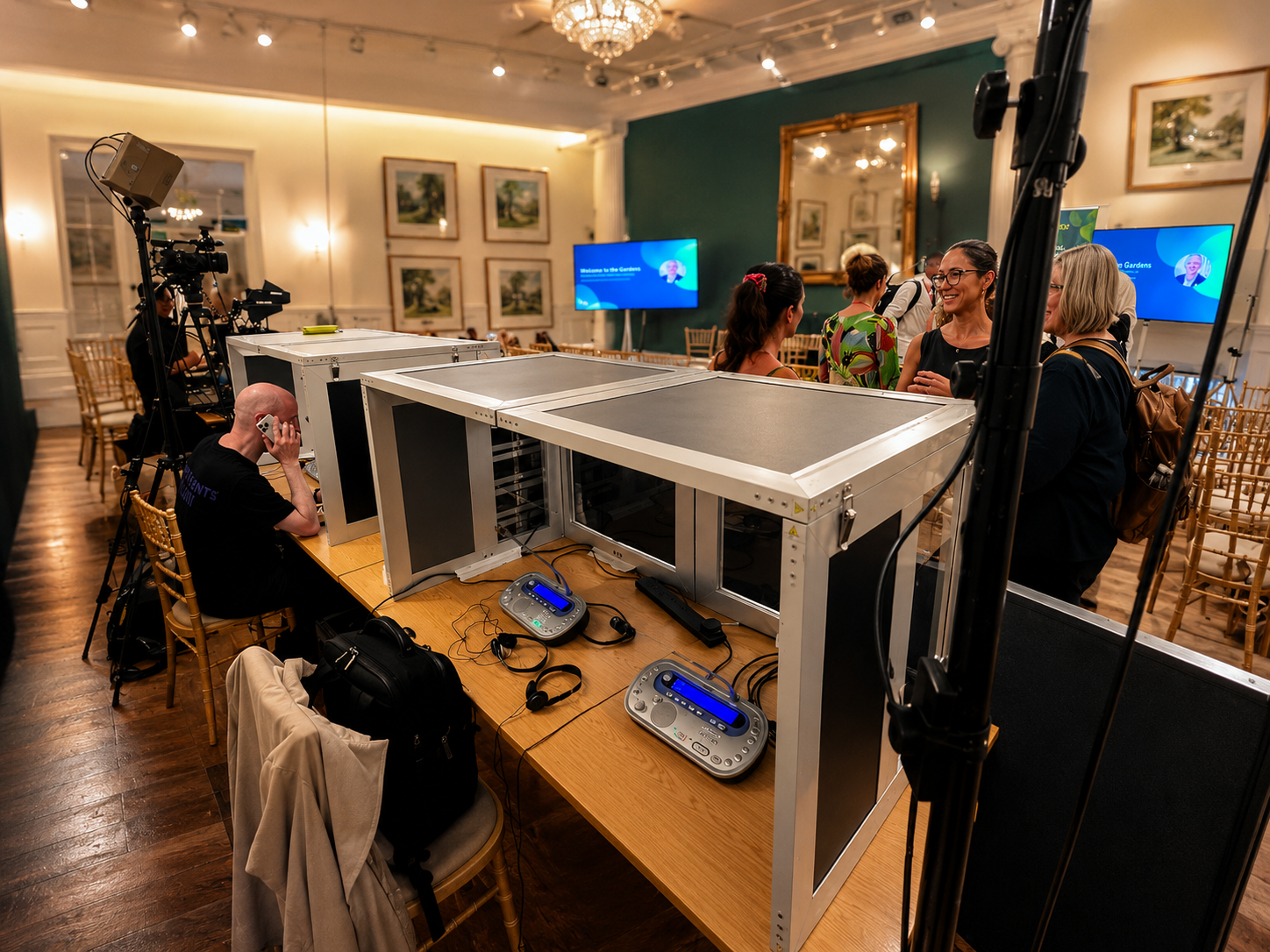
In a simultaneous interpreting booth, a team of two interpreters listens intently to a speaker through headphones while speaking the translation into a microphone in real time, with only a few seconds’ delay. It’s a high-pressure process demanding focus, language mastery, and seamless teamwork, all made possible by a soundproof booth, specialist consoles, and clear sightlines to the stage.
The doors close, the room hums, and behind the glass, two people slip on headsets. One listens. One prepares. Both carry the weight of every word.
From the outside, it looks effortless, a whisper-smooth voice flowing through hundreds of headsets as a speaker moves across the stage. But inside the interpreter’s booth, it’s a performance of precision. Every pause, tone, and gesture matters. Each word is caught, processed, and reborn in another language almost instantly.
What Is Simultaneous Interpreting And Why Does It Matter?
Simultaneous interpreting delivers a live translation without interrupting the speaker. Listeners hear the speech in their own language through wireless headsets, which is essential for global conferences and multilingual panels.
Unlike consecutive interpreting, where the speaker pauses after each phrase, simultaneous interpreting keeps the event moving. It’s used in summits, corporate briefings, and exhibitions where timing, rhythm, and flow are everything. The interpreters sit in isolated booths, speaking almost in sync with the presenter. For international companies and event organisers, it’s the difference between “inclusive” and “exclusive.”
When EMS Communications provides interpretation systems, the goal isn’t just translation. It’s to preserve the energy of the room and make sure every delegate, regardless of language, feels equally part of the conversation.
Step Inside the Booth, The Interpreter’s World
The interpreter’s booth is a soundproof, controlled environment where concentration meets technology. Acoustic insulation, consoles, and visual access to the stage keep every translation sharp.
The booth is designed for clarity. It’s sound-isolated to block out noise and keep the interpreters’ voices from spilling into the venue. Inside, each interpreter uses a console with mic controls, volume dials, and language channels, along with a high-fidelity headset to capture every nuance of the speaker.
They must see as well as hear; gestures, slides, and tone reveal intent. When working remotely, interpreters depend on high-quality video feeds for those same visual cues. EMS Communications ensures these feeds and signals stay stable, no matter how complex the event setup.
Inside the Mind of an Interpreter
Interpreters perform three mental actions at once: listening, processing, and speaking, which creates a split-second balancing act powered by focus and training.
While a delegate simply listens, the interpreter’s mind runs on overdrive. They listen actively, catching the rhythm and emotion of each line. Simultaneously, they analyse meaning, decide on the best phrasing, and reformulate the message in another language, all while anticipating what comes next.
They’re not parroting words; they’re re-creating meaning. This cognitive marathon can’t be sustained indefinitely. That’s why interpreters always work in pairs, switching every 20 to 30 minutes. One speaks, the other supports, checking figures, scanning glossaries, or catching proper names.
It’s teamwork at its most intense, quiet, invisible, and vital.
The Role of Teamwork Inside the Booth
Simultaneous interpreting is always done in pairs. One interprets while the other provides silent backup, monitoring terms, checking references, and staying ready to take over instantly.
This rhythm of alternation keeps the quality steady. During their “rest” period, the supporting interpreter isn’t idle. They’re cross-checking data, catching missed phrases, and signalling if adjustments are needed. The coordination is wordless, a nod, a scribble, a glance.
Over time, pairs develop an almost musical sync. That chemistry is what allows them to deliver flawless interpretations, even under pressure. EMS’s technicians recognise this dynamic, setting up booths and sound systems to keep interpreters comfortable, connected, and confident.
The Technology Behind the Magic
Flawless interpreting relies on professional equipment, soundproof booths, digital consoles, infrared transmitters, and wireless headsets, all of which EMS Communications supplies and supports.
- Interpreter consoles with microphone control and channel selection.
- Infrared and RF transmitters for uninterrupted, secure audio distribution.
- Delegate headsets that let listeners choose their language instantly.
- Portable soundproof booths are adaptable to any venue size.
- On-site technical teams who monitor connections and resolve issues on the spot.
No delays, no cross-talk, no static. Just seamless communication across languages.
What Happens During a Live Event
The interpreter listens through their headset, translates in real time, and their voice is transmitted to every delegate’s earpiece within seconds, with EMS’s live technicians supporting the process throughout.
When a keynote begins, the interpreters hear the original feed and immediately start translating. Delegates tune into their preferred channel and hear the translation as though the speaker were speaking their language.
In multilingual settings, interpreters sometimes use a relay system, translating from another interpreter’s version when direct understanding isn’t possible. Throughout the event, EMS Communications technicians track every signal, ensuring crystal-clear delivery across the room or across the world for hybrid events.
Beyond the Booth, Remote, Whispered, and Mobile Interpreting
Not all interpreting happens in a booth; modern technology allows remote, whispered, or portable setups for flexible event formats.
Today, many interpreters work remotely via specialised online platforms, where video and audio feeds replicate the in-booth experience. For small VIP meetings, whispered interpreting (chuchotage) offers personal translation without formal equipment.
For walking tours or site visits, mobile headsets and transmitters allow interpreters to move with their group. EMS’s portable systems adapt easily to each of these settings, offering the same clarity without sacrificing reliability.
Why Professional Equipment Hire Matters
Professional equipment prevents signal loss, sound delays, and confusion, saving the event’s credibility and the audience’s experience.
A multilingual event with poor audio can lose its message entirely. EMS Communications prevents that risk through pre-tested equipment, technical supervision, and scalable setups. Their solutions have powered everything from corporate boardrooms to ExCeL London exhibitions, combining human skill with engineering precision.
When every second counts, the right system doesn’t just support the interpreters. It supports the message itself.
Partner with EMS Communications
EMS Communications provides end-to-end simultaneous interpretation services and technical support across the UK, from conferences and exhibitions to corporate meetings.
If you’re planning a multilingual event, you need more than interpreters; you need the infrastructure that makes them shine. EMS brings together world-class interpretation equipment, acoustic booth design, and on-site technicians who understand the pace and pressure of live translation.
Get in touch with EMS Communications today to hire professional interpretation systems and expert support for your next conference or exhibition in London or across the UK.
FAQs
How many interpreters do I need for one language?
Usually, there are two interpreters per language, and they alternate every 20–30 minutes to maintain quality and focus.
Can the same setup handle multiple languages?
Yes. EMS systems can run several language channels simultaneously, managed through digital consoles.
Can this equipment work for hybrid or online events?
Absolutely. EMS Communications integrates remote interpreting feeds into virtual platforms without loss of quality.
How soon should I book interpretation services?
At least 4–6 weeks before your event to confirm booth placement, signal setup, and interpreter coordination.