
Nobody plans for the interpretation feed to drop halfway through a conference. But when it does, everyone relying on that language channel is suddenly left out of the conversation.
The speaker keeps talking. The room carries on. Delegates start checking their headsets, looking around, and wondering whether they have missed something important. Within seconds, a small technical fault can turn into confusion, lost trust, and a disrupted event.
That is why interpretation equipment failure is not just an AV issue. For multilingual conferences, AGMs, board meetings, negotiations and international events, it can affect understanding, participation and the whole flow of the room.
The good news is that most interpretation failures are not random. They usually come from predictable problems such as weak batteries, signal interference, loose connections, faulty receivers, or simple setup mistakes. And with the right checks, backup equipment and on-site support, most of them can be prevented before delegates ever notice a problem.
In this guide, we explain what really happens when interpretation equipment fails mid-event, why it happens, and how to build a backup plan that keeps every language channel running.
What Happens in the Room When Interpretation Equipment Fails?
When interpretation equipment fails mid-event, delegates on the affected language channel lose audio instantly, while the speaker and the rest of the room carry on unaware. That gap is what makes interpretation failure unusually disruptive: the people who can no longer follow are often the ones the event was arranged for in the first place.
The sequence is consistent across most failures:
1. Silence on the Channel
Headsets go dead or fill with static. Delegates first assume they have pressed the wrong button.
2. A Visible Lag In The Room
Affected delegates stop taking notes, look up, and start glancing around. Engagement drops before anyone reports a fault.
3. The Speaker Keeps Going
Without a cue, the presenter continues, so every second of downtime is content lost rather than paused.
4. A Scramble For The Cause
If no one is monitoring the interpreter output, the first “report” is a delegate raising a hand, by which point a minute or more has gone.
For a board meeting, a works council negotiation or a regulated AGM, even a short interruption can mean a point is missed, a vote is misunderstood, or proceedings have to be repeated. The cost of failure is rarely the equipment; it is the meeting time and the credibility of the event.
Why Does Interpretation Equipment Fail During Live Events?
Most mid-event interpretation failures come down to four causes: power loss, signal interference, equipment faults, and human error. Understanding which is which matters because the prevention for each is different.
1. Power Loss and Battery Drain
Wireless receivers, interpreter consoles and transmitters all depend on a power source, and the most common failure is the simplest: a battery that was not fully charged, or a transmitter knocked off mains power. In a full-day conference, receivers handed out at 9 am can fade by mid-afternoon if they were not charged overnight or swapped at the break.
2. Radio-Frequency Interference And Signal Dropout
Wireless and radio-frequency systems share the air in a busy venue. They compete with event radios, building Wi-Fi, mobile handsets, and large metal structures. In a crowded or RF-congested space, that can mean static, intermittent dropout or a channel that cuts out entirely. Infrared systems avoid radio interference. However, they need a clear line of sight. A pillar, a raised banner, or someone standing in the wrong place can block the signal.
3. Equipment Faults And Cabling
Connectors work loose, a console develops a fault, a headset cable frays, or a single receiver in a batch simply stops working. Individually, these are minor; mid-event, with no spare to hand, any one of them takes a delegate or a whole channel offline.
4. Human Error And Set-Up Mistakes
Human error is the largest avoidable category. Delegates tune in to the wrong channel. Someone mutes the console by mistake. Receivers are handed out without a quick check. Staff who have never used the system freeze when something seems wrong. None of these is an equipment fault. They are preparation gaps, which is exactly why they are so preventable.
How Do You Prevent Interpretation Equipment From Failing Mid-Event?
You prevent mid-event failures by building redundancy into the setup and testing the whole signal chain before doors open. No single device should be a single point of failure, and no fault should rely on a delegate to report it. The measures below map directly onto the four causes above and should be built into every interpretation plan for a large conference, from the start, rather than added after a problem appears.
Build In Redundancy And Carry Spares For Every Link In The Chain
- Keep spare receivers and headsets on hand, ideally 5–10% above headcount, so a dead unit is a swap, not an incident.
- Keep a configured backup transmitter ready so the most critical single device has an immediate replacement.
- Prepare charged battery stock and follow a swap routine at every break, rather than trusting one charge to last a full day.
Test The Full Signal Chain Before Doors Open
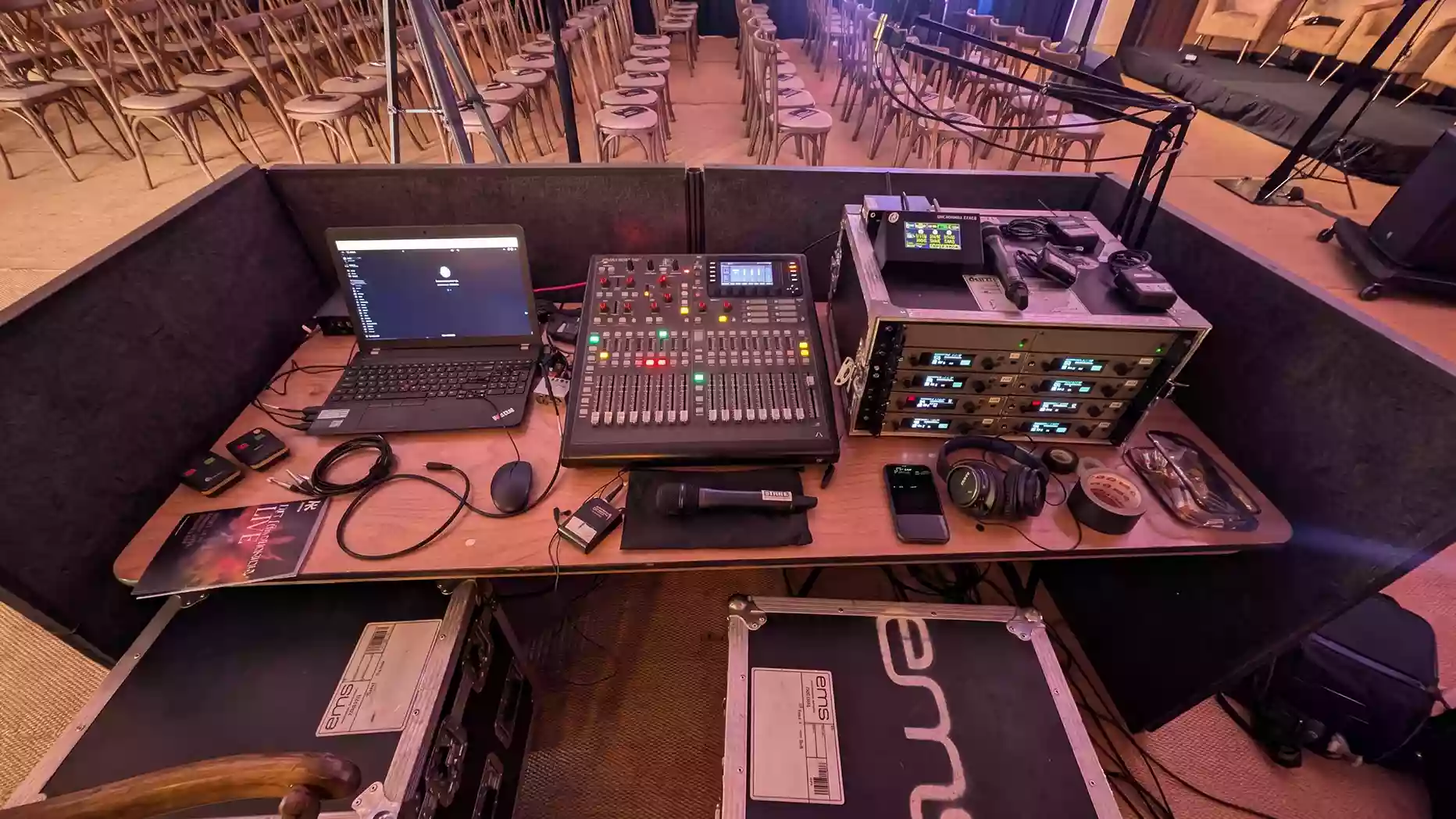
A pre-event check should cover the full signal chain: the interpreter console, transmitter, every channel and a sample of receivers. It should do more than confirm that the equipment powers on. A free site survey ahead of the event lets a provider plan frequency use, identify line-of-sight issues for infrared, and position equipment around the room layout before it becomes a live problem.
Coordinate Frequencies And Avoid Interference
In RF-heavy venues, choosing clear frequencies and using systems with frequency management reduces the risk of dropout. Where line of sight cannot be guaranteed, a wireless system is the safer choice than infrared. This is a planning decision, not a day-of one, which is why how you choose a wireless interpretation system for a large venue shapes how much can go wrong on the day.
Have A Person Watching The Output, And A Technician On Site
A redundant kit only helps if someone notices the fault. Monitoring the interpreter output means a dropout is caught in seconds rather than waiting for a delegate to raise a hand. For higher-stakes events, an on-site technician turns a potential stoppage into a quiet swap the room never sees. Briefing staff matters just as much: teaching your team how to work with interpretation equipment removes most human-error failures before they happen.
What Should You Do If Interpretation Equipment Fails During An Event?
If interpretation fails mid-event, the priority is to restore the channel fast and signal the speaker to pause if it cannot be fixed in seconds. A calm, rehearsed response keeps a fault from becoming a halt.
Switch To A Spare
Swap the failed receiver, headset or transmitter for a tested backup. With redundancy in place, this is the fastest fix.
Check The Obvious First
Checking the channel selection, battery level, mute setting and connections resolves a large share of ‘failures’ that are really set-up slips.
Cue The Speaker If Needed
If the channel cannot be restored quickly, a discreet signal to pause means content is delayed, not lost.
Escalate To The Technician
An on-site technician can isolate a transmitter or frequency fault while the backup carries the room.
Interpretation Failure Causes And Prevention At A Glance
| Failure cause | What delegates experience | How to prevent it |
| Power/battery drain | Channel fades or dies later in the day. | Overnight charging + battery swaps at every break. |
| RF interference/dropout | Static or intermittent cut-outs. | Coordinate frequencies and use wireless where a clear line of sight cannot be maintained. |
| Equipment fault/cabling | A receiver or channel goes silent. | Spare receivers, headsets and a backup transmitter on site. |
| Human error/set-up | Wrong channel, muted console, no audio. | Pre-event testing, receiver checks and briefed staff. |
The Role Of The Equipment Partner
Most of the prevention above, including redundancy, testing, frequency planning and on-site support, is decided by who supplies and runs the equipment, not by the event team on the day. A provider that maintains and tests its stock, carries spares as standard and integrates with your wider production crew turns interpretation from a risk into a non-event.
That coordination matters most at complex set-ups, where interpretation services have to integrate with your AV and event production team and slot cleanly into the audio and staging plan.
A reliable, well-maintained kit also reduces the failure rate. Reducing dropouts is the purpose of modern interpretation equipment, with frequency hopping, longer battery life and built-in redundancy helping to keep every channel clear.
Plan an Event That Cannot Drop the Feed
If you are running a multilingual conference, AGM or negotiation where the interpretation simply has to work, the safeguard is redundancy plus on-site support. It should be built in before the doors open, not improvised on the day. EMS Communications supplies tested interpretation equipment for hire across the UK, with spares as standard, free site surveys and technicians who keep the room running. Talk to our team about your event, and we will plan the setup around it.
Frequently Asked Questions
What is the most common cause of interpretation equipment failure?
Human error and set-up mistakes are the most common avoidable causes, such as wrong channel selection, a muted console, or receivers handed out without a function check. Pre-event testing and briefed staff prevent the majority of these.
Can you fix an interpretation failure without stopping the event?
Usually, yes. With spare receivers and a backup transmitter on site, most failures are resolved by swapping the affected device while the speaker continues. Only a fault that cannot be restored quickly requires the speaker to pause.
How much backup interpretation equipment do you need?
A common approach is to carry spare receivers and headsets equal to around 5–10% of the delegate count, plus a configured backup transmitter, so no single device is a point of failure. Your equipment provider should advise based on venue and headcount.
Is wireless or infrared interpretation more reliable?
Neither is universally better; it depends on the venue. Wireless avoids line-of-sight problems but can face radio interference in congested spaces; infrared avoids radio interference but needs a clear line of sight. Matching the system to the room is the reliability decision.