
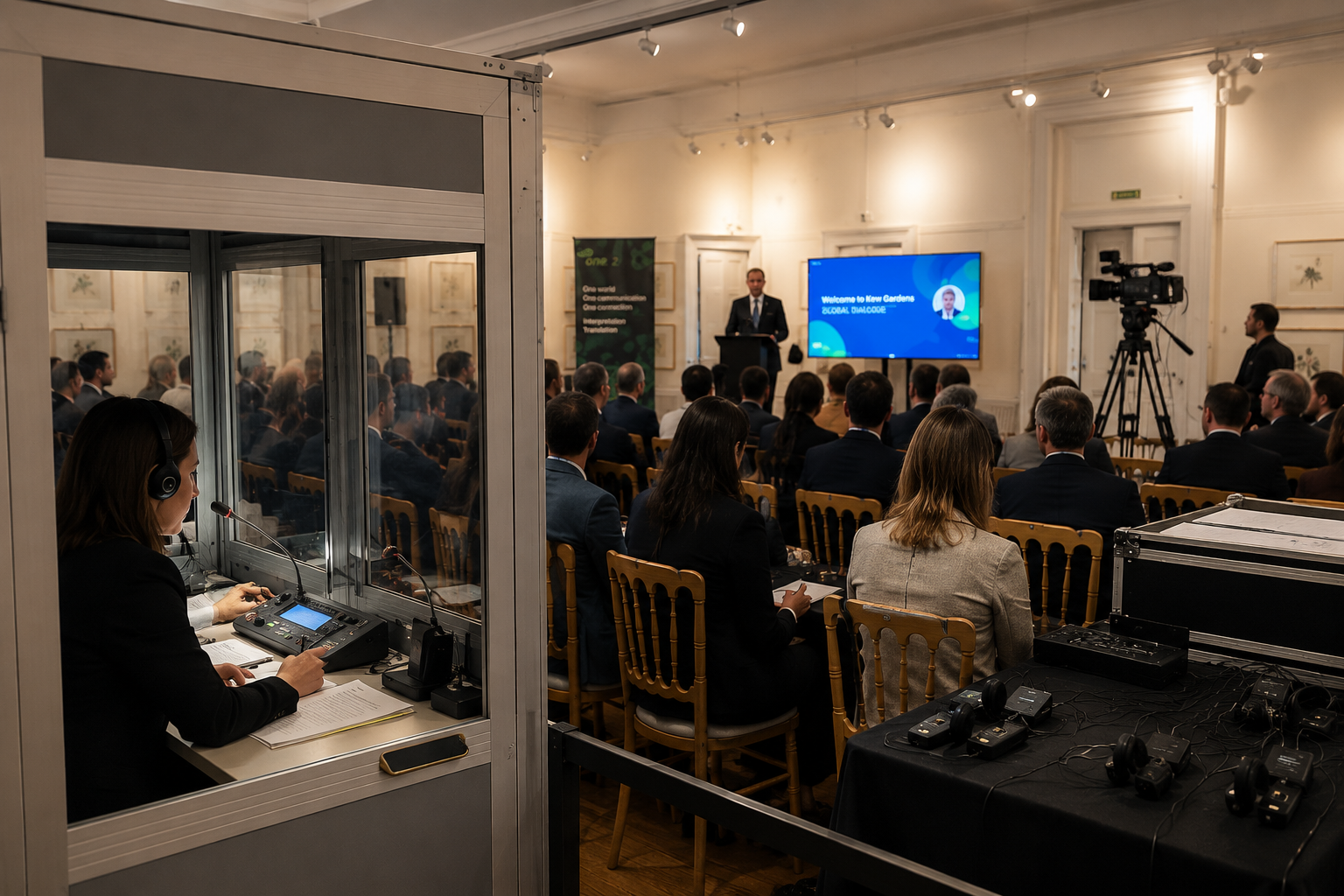
Most delegates at a London summit never think about the people in the booth. They listen, they nod, they take notes. But behind every smooth keynote in three languages sits a layer of work that most planners only notice when something goes wrong. That layer is the conference interpretation that London relies on every week, and it shapes how global events actually land with their audiences.
If you organise international conferences, you already know the risk. A speaker loses the room because the wrong dialect was assigned. A panel runs over because the interpreters have no clear handover. Headsets go quiet at the back of the hall. Each problem looks technical, but the cause is usually planning.
This guide walks through the hidden language layer behind global conferences in the capital. You will learn how interpretation is built into an event, what equipment matters, where planners go wrong, and how London’s setup compares with other cities.
Why London Has Become a Hub for Multilingual Events
London hosts more cross-border meetings than almost any other European city. Its mix of finance, government, legal, NGO, and trade activity pulls in delegates from every continent. That demand has built a deep pool of interpretation services, venues with built-in booth space, and AV teams who understand multilingual workflow.
For event communication, this matters in three practical ways:
- Talent depth. London-based agencies can call on hundreds of vetted interpreters across more than sixty languages, often at short notice.
- Venue readiness. Many central venues, including ExCeL, QEII Centre, and the Barbican, have permanent or semi-permanent booth provision.
- Technical infrastructure. Bosch Integrus systems, RF kits, and consoles are widely available, with full on-site support.
With 750+ professional interpreters covering 60+ languages, EMS Communications supports conferences, summits, and trade events across the UK.
| Quick fact: Most professional interpreters working at London conferences hold qualifications aligned with AIIC standards or ISO 18841, the international standard for interpretation services. |
How Interpretation Actually Works at a Global Conference
Interpretation is delivered live, in real time, while the speaker is still talking. That sounds simple. It is not. A typical international event in London uses one of three modes:
| Mode | How it works | Best for |
| Simultaneous | Interpreters work in soundproof booths, and delegates listen on headsets. | Conferences, summits, plenaries. |
| Consecutive | Speaker pauses, the interpreter renders the message. | Small meetings, press briefings, legal sessions. |
| Whispered (chuchotage) | Interpreter whispers to one or two delegates. | Site visits, board meetings, VIP support. |
Simultaneous interpretation is the standard for global conferences because it keeps the agenda moving. It also brings real planning demands that organisers often underestimate.
What the Hidden Language Layer Actually Includes
It includes far more than hiring interpreters. Good global communication depends on people, equipment, venue conditions, and timing working together in real time.
1. Professional Interpreters With The Right Subject Fit
Interpreters do not just convert words. They handle pace, terminology, tone, speaker intent, and live pressure. For finance, legal, medical, governmental, and technical conferences, subject familiarity matters because one unclear phrase can affect trust, compliance, or decision-making. EMS Communications’ own brief positions its interpreters at a minimum of five years’ experience, which is exactly the kind of operational detail serious planners look for.
2. Equipment That Supports Clear Event Communication
Interpretation delivery usually depends on consoles, transmitters, microphones, headsets, and proper booth setup. EMS Communications lists interpretation booths, tabletop booths, infrared and RF systems, PA systems, LED screens, and wireless microphones among its core equipment, and it highlights the Bosch Integrus System as a flagship technology for multilingual delivery.
3. Booth Standards And Working Conditions
Booth quality is not a minor detail. ISO 17651-2:2024 is the current published standard covering requirements and recommendations for mobile booths for simultaneous interpreting, and the European Commission’s interpreting guidance says booths should be soundproofed, well-lit, and provide a direct and complete view of delegates. That matters because interpreters work from both sound and visual cues.
4. AV Integration From The Start
Interpretation and AV must be planned together. Early coordination between interpretation providers, AV teams, and production managers ensures signal paths, booth sightlines, power, rehearsals, and audience receivers all work as one system. This is especially important for hybrid conferences and live multilingual events where delay, echo, or weak feeds can undermine the whole room.
A simple way to think about the hidden language layer is this:
- Interpreter team: matched to the language pair, subject matter, and event pressure.
- Audio path: clean feed from microphone to console to receiver.
- Booth setup: proper sightlines, ventilation, lighting, and access.
- Audience delivery: reliable headsets or listening devices for every required language.
- Technical cover: on-site checks, rehearsal support, and live troubleshooting.
- Production alignment: stage management, AV, and interpretation all working from the same run-of-show.
The Interpreter Team You Actually Need
A common mistake is booking only one interpreter per language. For sessions over 45 minutes, two interpreters per language booth are the working norm. They swap every 20 to 30 minutes because the cognitive load of live interpretation is intense. Skip this, and accuracy drops in the second hour, sometimes badly.
For high-stakes content, three interpreters per language is sensible. Legal hearings, medical congresses, and technical product launches all sit in this group.
Equipment That Holds The Room Together
The interpreter is only one half of the system. The other half is the technical kit. Behind every clean delivery sits:
- A soundproof or portable booth that meets ISO 4043 (mobile) or ISO 2603 (built-in) standards.
- Interpreter consoles with relay channels.
- Wireless transmitters and receivers, usually infrared for security.
- Delegate headsets, microphones, and a PA system that feeds the booth cleanly.
For sensitive sessions, infrared distribution is preferred over RF because the signal does not pass through walls. EMS Communications uses the Bosch Integrus System for this reason. It is widely treated as the gold standard for secure, high-fidelity interpretation delivery in London and across the UK.
Where Language Barriers Usually Appear at International Events
They usually appear long before the first delegate puts on a headset. Most problems start in planning, then become visible during delivery.
Here is where conference organisers most often get caught out:
| Planning point | Why it matters | What to confirm early |
| Language mix | A multilingual audience may need more than one live channel | Which languages are required, and for which sessions? |
| Venue layout | Poor booth sightlines affect interpreting quality | Can interpreters see the stage, screens, and speakers clearly? |
| Audio routing | Bad source audio leads to bad interpretation | Are presenter mics feeding a clean signal to interpreter consoles? |
| Session format | Panels and Q&A are harder than scripted speeches | Are there live questions, remote speakers, or changing moderators? |
| Rehearsal time | Last-minute tests miss real issues | Has the full interpretation chain been tested with AV? |
| On-site ownership | Problems grow fast if no one is accountable | Who is managing language delivery on the day? |
Each of those points affects cross-border communication in practical ways. A booth hidden behind a drape, a missing monitor feed, or a late speaker deck can all reduce accuracy. That is why the European Commission’s guidance focuses on booth conditions and visibility, and why EMS Communications stresses integrated planning, rehearsals, and interpretation-aware technical coordination.
How to Plan Multilingual Conference Support
The best approach is to plan language services at the same stage as room layout, stage audio, and delegate experience. That gives you better technical choices, fewer day-of-event surprises, and stronger event communication for every language channel.
A practical planning sequence looks like this:
1. Map the Audience and Languages First
Identify who needs interpretation, which sessions need it, and whether all rooms require the same setup. This avoids overbooking in some areas and leaving your most important sessions under-supported.
2. Decide On The Interpreting Format
Simultaneous interpretation is usually the right fit for conferences, panels, and international meetings because it keeps the programme moving.
3. Check Booth And Equipment Standards
For mobile booths, current guidance points to ISO 17651-2:2024. For equipment and facilities more broadly, the European Commission lists relevant standards covering booths and simultaneous interpreting equipment. That gives planners a solid benchmark when reviewing suppliers and venue readiness.
4. Integrate Interpretation Into The AV Plan
Booth position, monitor feeds, receiver distribution, cable routes, and backup procedures should all be discussed with the AV team before show day.
5. Build Rehearsal And On-Site Support Into The Schedule
Rehearsals should include interpreters where possible, not just speakers and AV technicians.
For London conferences, that planning discipline matters even more because venues vary so widely. A Westminster conference centre, a hotel ballroom near the City, and an exhibition hall setup all create different booth, sound, and delegate-flow demands. A central London supplier with both interpreters and equipment can usually solve these issues faster because it handles the language layer and the technical layer together.
Where Planners Go Wrong With Conference Interpretation
Most interpretation problems trace back to four planning gaps. Each one is avoidable with the right brief and the right partner.
- Briefing too late: Interpreters need the agenda, speaker notes, slide decks, and any technical glossary at least one week before the event. Last-minute briefings reduce accuracy on names, acronyms, and figures.
- Wrong dialect or register: Spanish for a Madrid audience is not the same as Spanish for a Mexico City audience. Mandarin used in a finance setting differs from Mandarin in a manufacturing context. Match the interpreter to the audience, not just the language.
- Underbuilding the equipment: Booths placed at the back of a hall, weak line of sight for IR, or insufficient headsets all create avoidable failures. Equipment hire should be planned with the room layout, not after it.
- No project manager on the day: When a microphone fails or a session shifts rooms, someone needs to coordinate the booth, the AV team, and the chair. A dedicated project manager assigned to every event by EMS Communications removes that risk.
For organisers running cross-border communication on tight timelines, working with trusted simultaneous interpretation services early in the planning cycle is the single biggest lever on event success.
Common Checklist Before Any Multilingual Event
- Confirm languages and dialects against the actual audience, not the registration list.
- Book two interpreters per booth for any session over 45 minutes.
- Share full briefing materials at least seven days before the event.
- Walk the room with the AV team to confirm booth placement and IR coverage.
- Test all headsets, consoles, and transmitters on the morning of the event.
- Agree on a clear escalation contact for the project manager.
- Plan a post-event debrief to log issues for the next conference.
What ‘Good’ Looks Like for a London Conference
A well-run multilingual event has a quiet rhythm. Delegates change channels without thinking. Speakers do not rush. Interpreters hand over without a break in delivery. The technical team monitors signal levels in the background. No one in the audience is aware of the work, and that is exactly the point.
For organisers managing a multilingual audience, the right partner brings four things together: experienced interpreters, proven equipment, a clear project manager, and 24/7 technical support.
Conclusion
The hidden language layer behind a global conference is not glamorous. It involves briefings, booths, headsets, console checks, and a project manager who knows the agenda inside out. Get it right, and the event simply works. Get it wrong, and the language barriers show up in every Q&A.
London has the talent, the venues, and the technical infrastructure to host world-class multilingual events. The deciding factor is who you plan with.
Speak to EMS Communications if you are planning a multilingual conference, government meeting, or international event in London or anywhere in the UK. With 25 years of interpretation expertise, 750+ professional interpreters covering 60+ languages, Bosch Integrus-based delivery, and 24/7 technical support, we can help you plan the language layer with confidence. Call 0207 820 3444 or email us at [email protected].
Frequently Asked Questions
How Much Does Conference Interpretation in London Cost?
Costs depend on languages, number of interpreters, session length, equipment, and venue. A single-language half-day session sits at the lower end. Multi-language, multi-day conferences with full equipment hire and on-site support sit higher. The most reliable approach is a tailored quote based on your agenda, room layout, and audience size.
How Far In Advance Should I Book Interpreters For A London Conference?
For common languages such as French, Spanish, German, or Mandarin, four to six weeks is comfortable. For rarer languages or high-stakes legal and medical content, eight to twelve weeks is safer. Late bookings are possible through agencies with deep interpreter pools, but choice and dialect matching narrow quickly.
What Is The Difference Between Simultaneous And Consecutive Interpretation?
Simultaneous interpretation is delivered live while the speaker is talking, using booths and headsets. It suits conferences and large international events. Consecutive interpretation happens in pauses, with the interpreter rendering the message after each segment. It suits smaller meetings, press briefings, and legal sessions where timing is less pressured.
Do I Need Separate Equipment For A Hybrid Or Virtual Conference?
Yes. Hybrid and virtual events need a configured audio chain that feeds clean speaker audio to the interpreters and clean interpreted output to remote delegates. This usually involves dedicated platforms or hardware bridges alongside the standard booth setup. Plan this with your AV and interpretation team together, not separately.