
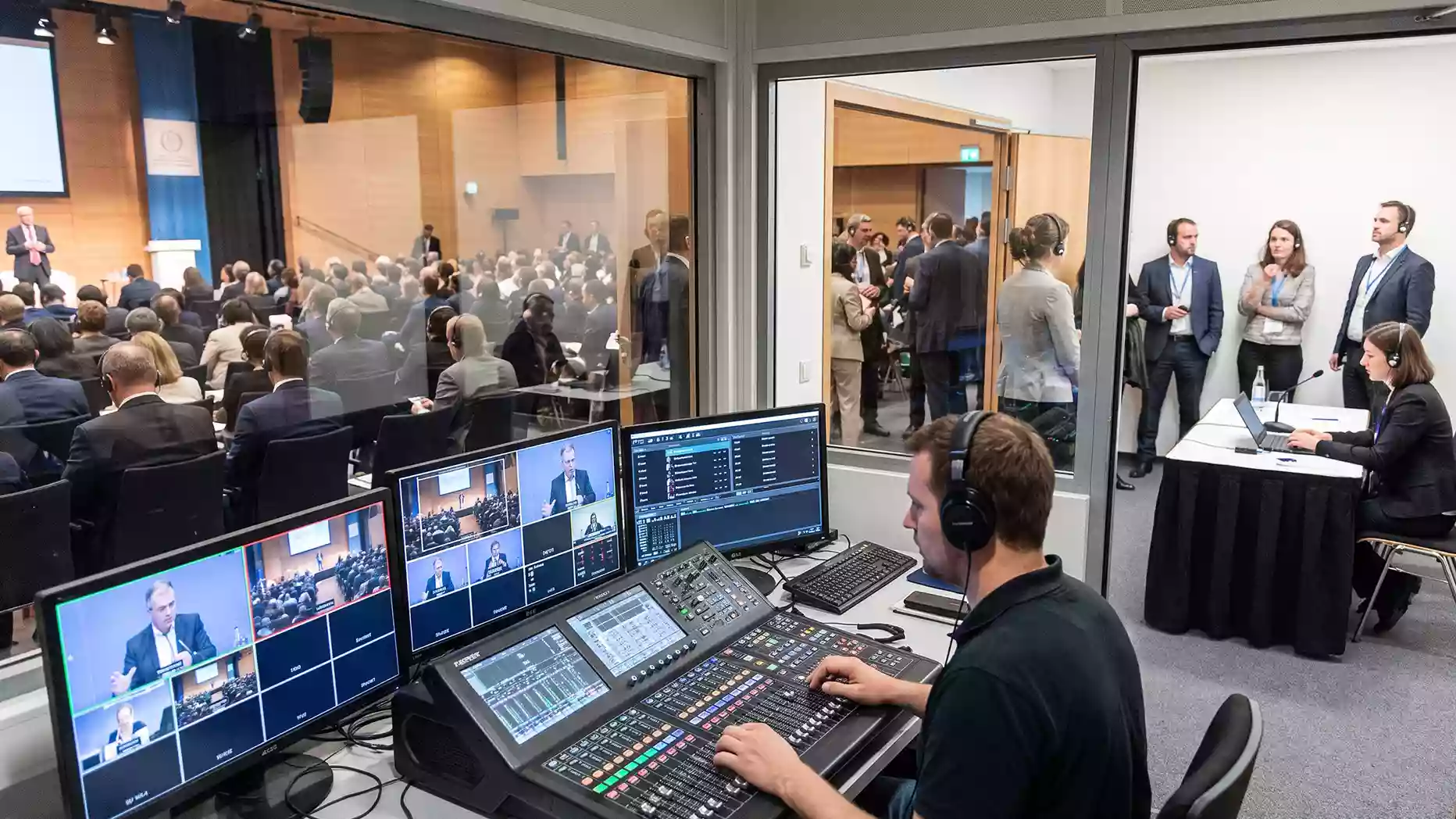
Scaling interpretation services means planning the people, equipment, language channels and technical support before your agenda becomes too complex. When an event moves from one room to several rooms and conference sessions, interpretation can no longer be treated as a simple add-on.
Multi-room events need clear control of audio channels. They need trained interpreters. They need tested interpreting systems. They also need a project plan that covers the whole event. If a breakout room changes language, delegates may be listening on the wrong receiver channel. If an interpreter cannot see the speaker, the audience’s experience can quickly break down.
This guide explains how to scale a multilingual setup without losing quality. You will learn how to plan interpreter teams, assign language channels, match equipment to rooms, avoid common event logistics mistakes and keep delivery consistent across large conferences.
Why Does Scaling Interpretation Services Need Early Planning?
Scaling interpretation services requires early planning because every extra room, session and language adds pressure to the setup. The earlier you map these details, the easier it is to protect sound quality, interpreter workflow and audience access.
For a single-room meeting, your setup may be simple. You may need one booth, one language pair, a small number of headsets and one technician. For multi-session events, the plan becomes more detailed.
You may need:
- Different language channels in different rooms.
- Interpreters assigned by subject area.
- Portable booths for breakout sessions.
- Headsets and receivers for each audience group.
- A technician or runner for each active zone.
- Clear signage so delegates know which channel to use.
- A central contact for changes during the event.
This is where event coordination matters. The interpretation plan should sit alongside the main production plan, not behind it. As you build your timeline, our guide to planning a multilingual event is a useful reference for adding language access, interpreter briefs, channel testing and headset distribution to the same plan.
Start With the Agenda, Not the Equipment List
The agenda tells you what the interpretation system must do. Before choosing booths or headsets, review the full programme.
Look at:
- How many rooms are active at the same time?
- Which sessions need interpretation?
- Which sessions share the same audience?
- Which languages are needed in each room?
- Whether sessions include Q&A, panels or live voting.
- Whether any speakers are remote.
- Whether interpreters need slides, scripts or glossaries.
Once you have this picture, our step-by-step guide to creating an interpretation plan for large conferences helps you turn the agenda into a working technical plan.
How do you manage language channels across multiple rooms?
You manage language channels by assigning each room, language and session a clear channel plan before the event. This prevents overlap, confusion and wrong-language audio during live delivery.
Channel management is one of the most important parts of conference scaling. At a large multilingual event, delegates may move from a keynote to breakout rooms, then return to a plenary session. If the channels are not consistent, people waste time switching receivers or asking staff for help. For wider guidance, see our best practices for managing multiple languages at simultaneous events.
A basic channel plan may look like this:
| Area | Session type | Languages | Channel plan | Equipment need |
|---|---|---|---|---|
| Main hall | Keynote | English, French, German | Floor plus channels 1 and 2 | Booths, consoles, IR or RF receivers |
| Breakout room 1 | Technical workshop | English, Spanish | Channel 1 | Portable booth, headsets, microphones |
| Breakout room 2 | Legal panel | English, French | Channel 1 | Booth or Whisper Cube, receivers |
| Hybrid room | Remote panel | English, Arabic | Platform audio feed plus receiver channel | RSI feed, technician support |
Powered by the Bosch Integrus System, the gold standard in interpretation, EMS Communications can support high-quality audio delivery for professional multilingual events. The Integrus system handles up to 32 channels: the floor language plus 31 interpretation channels. It distributes audio over infrared. Because infrared signals are contained within the walls of a room, audio from one breakout cannot bleed into the next. Physical isolation is especially important when rooms sit side by side, which is exactly what multi-room events create. Bosch interpretation systems help you manage controlled language channels, provide reliable receivers and give delegates a clearer listening experience.
For larger venues, it is worth reviewing how to choose a wireless interpretation system for large venues. Do this before you decide between infrared, RF wireless systems, or platform-based delivery.
Keep Language Labels Simple for Delegates
A technically correct setup still fails if delegates do not know what to do.
Use simple labels such as:
- Channel 1: French
- Channel 2: German
- Channel 3: Spanish
- Channel 4: Arabic
Repeat these labels on signage, printed agendas, holding slides and registration instructions. For multi-room events, add room names too. For example: “Breakout Room B, French, Channel 1.”
Small details reduce pressure on front-of-house staff and help international attendees feel included from the start.
How many interpreters and booths do multi-session events need?
Multi-session events need enough interpreters and booths to cover each active language, room and session without overloading the team. The final number depends on the agenda, session length, subject complexity and whether sessions run at the same time.
Simultaneous interpreters work under intense listening and speaking pressure. For longer sessions, interpreters normally work in pairs so they can alternate, typically swapping every 20 to 30 minutes, which protects accuracy across a long day. This is especially important for technical, legal, medical, financial or policy-led conference sessions. Scaled across rooms, the numbers rise fast. Three rooms needing two interpreted languages can mean about twelve interpreters in rotation, not six.
Use this simple planning checklist:
- Count active rooms by time slot.
- List the languages needed in each room.
- Identify sessions with specialist terminology.
- Confirm session length and breaks.
- Decide if interpreters are on-site or remote.
- Match booths, consoles and headsets to each room.
- Build in setup and rehearsal time.
- Assign one clear technical escalation route.
If you are unsure about team size, start by reviewing how many conference interpreters you will need.
Choose Booths Based on Room Use
Not every room needs the same booth setup. A main hall may need full interpreter booths with clear audio feeds and sightlines. A smaller workshop may work well with portable interpretation booths or the Whisper Cube portable booth system. When quality matters, portable interpretation booths that meet the ISO 4043 standard give interpreters a controlled acoustic environment. This directly affects interpretation quality.
For smaller rooms, portable interpretation booths can be a practical option. They help control sound, support interpreter focus and avoid placing interpreters directly in noisy audience areas.
For hybrid or virtual sessions, interpretation for hybrid and virtual conferences may be the better fit. Remote interpreters still need clear audio, visual access, a tested platform and a backup process if the connection drops.
How Do You Protect Quality While Scaling Interpretation?
You protect quality by treating interpretation as part of the live production system. It must connect with AV, microphones, screens, speakers, rehearsal schedules and technical support.
When interpretation is scaled badly, problems often appear in the same places:
- Speakers use handheld mics incorrectly.
- Panel microphones are not routed to interpreters.
- Breakout rooms are added late.
- Slides are not shared with interpreters.
- Delegates receive headsets without channel guidance.
- Remote speakers have poor audio.
- Interpreters cannot see the speaker or the screen.
- Technicians are not briefed on language channels.
This is why EMS Communications assigns a dedicated project manager and provides 24/7 technical support. The project manager keeps the event logistics connected, while technicians make sure interpretation systems, microphones, transmitters, PA systems and headsets are tested before delegates arrive.
If your interpretation plan needs to connect with wider AV production, treat integration with the AV and event production team as a core planning step rather than an afterthought.
Add a Technical Rehearsal for Every Active Room
A rehearsal should test more than the main stage. It should test every room where interpretation is live.
Check:
- Speaker microphones.
- Interpreter audio feed.
- Outgoing language channels.
- Headset volume and clarity.
- Channel labels.
- Booth placement.
- Screen visibility.
- Remote speaker audio.
- Backup microphones.
- Staff escalation process.
For large conferences, the rehearsal should also include timed room changes. This helps the team check whether receivers, signage, staff support and interpreters are ready for delegates moving between sessions.
| “The crew was very helpful, arrived on time, and the service was very professional at all times.” Christiana Hambro, Henry Jackson Society |
That kind of delivery matters even more when you are scaling interpretation across several rooms. Multi-session interpretation is not only about having enough equipment. It is about having a prepared team that understands the pressure of live events.
What Is the Best Scaling Process for Event Organisers?
The best scaling process is to create one central interpretation plan and then break it down by room, session, language and technical requirement. This gives the organiser, project manager, interpreters and AV team one shared view. For events with several suppliers, it also helps to know how to coordinate multiple interpretation vendors for large-scale events.
A practical process looks like this:
Step 1: Share the full event brief
Send the agenda, floor plan, speaker list, language requirements, expected delegate numbers and session formats. Include whether the event is in-person, hybrid or fully remote.
Step 2: Build the language matrix
Map each language to each room and session. Include the audience size for each language group if known.
Step 3: Confirm interpretation method
Choose simultaneous interpretation, consecutive interpretation, whispered interpretation or remote interpretation based on the session format.
For high-stakes live sessions, simultaneous interpretation systems are often preferred because delegates can listen in real time. This helps keep the agenda moving.
Step 4: Match equipment to the venue
Select booths, interpreter consoles, headsets, microphones, transmitters, IR or RF wireless systems, and PA support. Base your choice on venue size and room layout. Our trusted simultaneous interpretation services bring the equipment, interpreters and on-site coordination together under one project manager.
Step 5: Prepare interpreters properly
Send slide decks, speaker notes, glossaries, speaker names, acronyms and technical terms early. This is one of the simplest ways to improve quality. It also helps to brief internal teams, speakers and moderators on how to work with interpreters before the event.
Step 6: Run a full technical check
Test every active room, every receiver batch, every language channel and every remote feed. Do this before the audience enters the venue.
Step 7: Keep support live during the event
Multi-room events change quickly. Speakers overrun. Delegates move rooms. Sessions are swapped. A live technical support team helps keep interpretation steady when the agenda changes.
Scale With a Plan, Not a Panic
Scaling interpretation services is not about adding more headsets at the last minute. It is about planning the people, rooms, sessions, language channels and technical support before the event goes live.
For multi-room events and large conferences, the best results come from early planning, proper channel management, clear delegate guidance and tested interpretation systems. When every room is planned correctly, multilingual attendees can follow the event without confusion or delay.
Speak to EMS Communications about your next multilingual conference or multi-session event. With 25 years of interpretation experience, the team can help.
- We work with 750+ professional interpreters.
- We cover 60+ languages.
- We support the Bosch Integrus system for professional simultaneous interpretation.
- We can plan, supply, test and support the right setup across Central London and the UK.
Call 0207 820 3444 or email us at [email protected].
FAQs
How early should I plan interpretation for a multi-room event?
Start planning interpretation as soon as the agenda, rooms and target languages are known. For large conferences, early planning helps secure the right interpreters, booths, headsets and technicians. It also gives interpreters time to review slides, terminology and speaker notes before the event.
How much does scaling interpretation services cost?
The cost depends on the number of rooms, languages, interpreters, headsets, booths, technical staff and event duration. Multi-session events usually cost more than single-room meetings because they need more planning, equipment and live support. Ask for a tailored estimate based on your agenda.
Can one interpreter cover multiple conference sessions?
One interpreter should not be expected to cover overlapping sessions or long simultaneous sessions without support. Interpreter planning depends on timing, subject matter, language pair and session length. For quality control, longer simultaneous sessions usually need two interpreters who rotate every 20 to 30 minutes, not one.
Is remote simultaneous interpretation suitable for multi-session events?
Yes, remote simultaneous interpretation can work well for multi-session events. It works best when audio, platform, internet and backup plans are fully tested. It is useful for hybrid conferences and specialist languages. It still needs strong technical coordination and clear communication with the AV team.
What equipment is needed for multi-room interpretation?
Common equipment includes interpreter booths, consoles, headsets, receivers, transmitters, microphones, PA systems and IR or RF wireless systems. Hybrid sessions may also need platform integration, remote audio feeds and technician support. The exact setup depends on the venue, room layout and event agenda.