
Most event plans treat interpretation as a box to tick. Book the interpreters, hire the headsets, done. Then the event happens. The Q&A falls flat, the opening joke reaches half the audience and confuses the other half of the room, and the international delegates sit quietly through the whole afternoon.
The reason is that the words were translated; the meaning often was not. Formality, humour, dialect, and tone all change from culture to culture, and they carry more of the message than most organisers expect. Professional interpreters handle this in real time, and that skill is what makes a multilingual event feel natural. This article explains what that work involves, where it usually goes wrong, and what to plan for.
Language Barriers Are Usually Culture Barriers
Listen to the complaints after a poorly interpreted event, and you will notice something. Delegates rarely say they could not understand the words. They say the speaker sounded rude. Or vague. Or that a joke made no sense. The vocabulary arrived. The intent did not.
That happens because meaning lives in more places than words:
- Formality: Some business cultures expect direct, explicit statements. Others find directness disrespectful. The same sentence needs a different delivery in Frankfurt than it does in Tokyo.
- Dialect: French in Paris is not French in Kinshasa. Arabic for a Gulf ministerial panel is not Arabic for a Levantine trade audience. Vocabulary, formality and technical terms all shift by region.
- Humour and idiom: A cricket metaphor rarely survives a literal translation. The audience either hears an equivalent or hears nothing useful.
- Pacing: A pause reads as emphasis in one culture and as hesitation in another. If the interpreter loses the speaker’s rhythm, the audience loses the signal.
A bilingual colleague can manage the vocabulary. Managing all four of these at once, at conference speed, is a separate profession. It is the main reason a bilingual person should not be hired instead of a professional interpreter for anything important.
| Quick fact: Professional conference interpreters work in line with AIIC standards and ISO 18841, the international standard for interpreting services. Both treat cultural and subject competence as core requirements, on the same level as language proficiency. |
What Interpreters Actually Do in the Booth
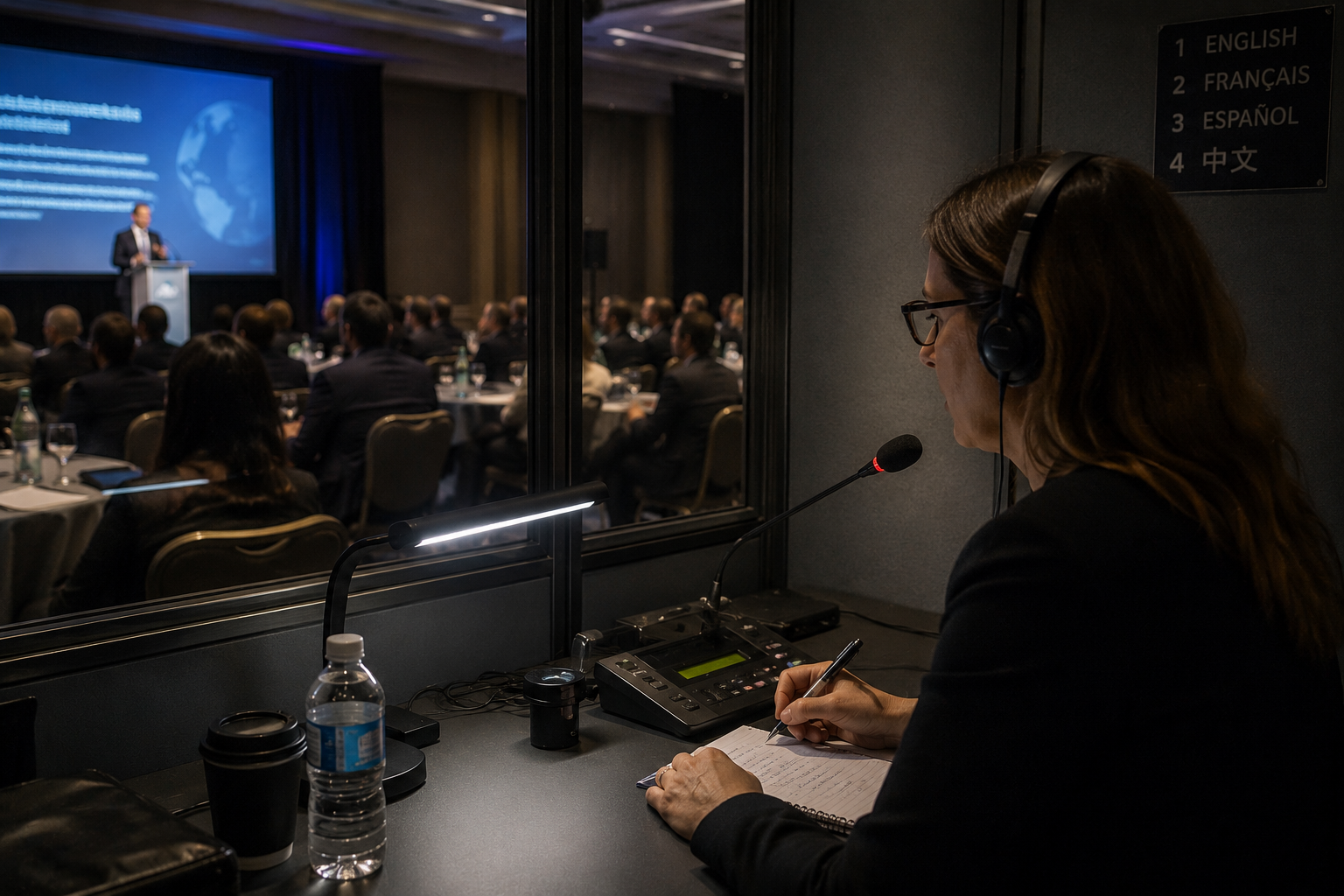
A simultaneous interpreter works a few seconds behind the speaker. The trade calls this lag the décalage. In that window, the interpreter is listening to the source language, rebuilding the grammar in the target language, choosing the right level of formality for the audience, and deciding what to do with any idiom that just landed. All at once, all day.
Some of this work only becomes visible when you know what to look for:
| Live situation | What it sounds like done badly | What a professional does |
| Scripted speech read at speed | The interpreter falls behind, and the output fragments | Requests the script in advance and compresses without losing substance |
| A joke or idiom | A literal rendering, then silence in the hall | Finds an equivalent, or carries the tone so the intent survives |
| Diplomatic wording | Careful hedging flattened into a blunt yes or no | Keeps the hedge. The speaker put it there on purpose |
| Names, acronyms, figures | Hesitation and near-misses on numbers | Prepares from glossaries and checks figures against the slides |
| A mixed-region audience | One dialect is privileged, half the room is left out | A dialect-matched interpreter assigned at booking |
| Panel Q&A | Crosstalk and missed handovers between languages | Relay discipline and clean booth handovers |
That last row deserves attention. Panel discussions and open Q&A are the hardest format in interpretation. Nothing is scripted, the pace is fast, and questions in one language often need to reach a panellist through a second language by relay. Q&A is also where cross-cultural engagement actually happens. If the interpreting team can hold a live Q&A together, the rest of the agenda is easy by comparison.
The intensity of this work is why the staffing rule exists. Any session over 45 minutes runs with two simultaneous interpreters per language, swapping every 20 to 30 minutes. Fatigue erodes fine judgement first, and cultural judgement is the finest there is. For this reason, EMS Communications staffs every assignment from a pool of more than 750 interpreters across 60+ languages. Each one has at least five years of conference experience and is matched on subject and region, not just on language pair.
Tone Needs Clean Audio to Survive
Everything an interpreter does with tone and nuance reaches the delegate as audio. If the audio is poor, the cultural layer goes first. Warmth flattens. Emphasis disappears. A carefully judged delivery arrives sounding mechanical.
So the technical setup is part of the cultural work, not a separate job:
- Booth position and sightlines. Interpreters read faces, gestures and slides as well as voices. A booth tucked behind a drape with no monitor feed is working half blind.
- Source audio. The interpreter’s output can only be as clear as the feed coming into the console. Clean routing from the presenter microphones comes before everything else.
- Distribution. Infrared is the conference standard for good reasons. The signal stays inside the room, which matters for closed sessions, and coverage is predictable when it is planned against the room layout.
EMS Communications runs this chain on the Bosch Integrus System. The booths, consoles, transmitters and delegate headsets are maintained and tested by its own technicians, and set up against the room rather than dropped into it. The full chain, from microphone to headset, is the core of how simultaneous interpretation works.
Where Organisers Lose the Cultural Layer
Almost always in planning, weeks before the event. The problems that appear on the day trace back to a few early decisions:
| Decision point | The common shortcut | The cost on the day |
| Audience profiling | Languages copied off the registration list | Wrong dialects, wrong formality, alienated delegates |
| Interpreter briefing | Materials sent the night before, or never | Names, acronyms and figures suffer first |
| Speaker preparation | Speakers never told interpretation exists | Scripts read at sprint pace, idioms everywhere |
| Staffing | One interpreter per language to save budget | Accuracy visibly drops in the second hour |
| Equipment | Booths placed after the room is designed | Blind booths, patchy coverage, flat tone |
| Day-of ownership | Nobody assigned to the language layer | Small faults grow mid-session |
Two of these cost nothing to fix. The first is briefing. Send the agenda, the slide decks, the speaker names and a terminology glossary a week ahead, and every judgement made in the booth improves. The second is speaker preparation. A steady pace, pauses between key points, and idioms used knowingly do more for output quality than most equipment upgrades. The basics of how to work with interpreters fit on one page, and speakers will actually read one page.
The last row in the table is an operational choice. When a panel overruns or a microphone fails, someone has to own the language layer while the show keeps moving. EMS Communications assigns a dedicated project manager to every event for exactly this reason, so problems get fixed mid-session and the audience never finds out there was one.
| Planning Checklist: Interpretation for a Multicultural AudienceProfile the audience by region, sector and seniority, not just language.Confirm dialect requirements with your provider at booking, not on site.Send agendas, decks, speaker names and a glossary at least seven days out.Brief the speakers: steady pace, pauses, idioms used sparingly, scripts shared in advance.Staff two interpreters per language for any session over 45 minutes, and consider three for legal, medical or highly technical content. Walk the room with the AV team to fix booth position, sightlines and coverage.Test the full chain on the morning: microphone, console, transmitter, headset.Name one escalation contact for the language layer on the day. |
What Good Looks Like
There is a simple tell at a well-interpreted event: the international delegates behave like locals. They ask questions without rehearsing them first. They laugh a beat after the room, but they laugh. They disagree with a panellist across a language boundary, and the conversation stays productive, because the tone arrived intact. And nobody mentions the interpretation in the feedback forms, which is the best review a booth ever gets.
Conclusion
Professional interpretation improves cross-cultural communication by doing what translation alone cannot. It carries formality, dialect, humour and intent between cultures in real time, on equipment that protects tone, with planning that respects who is actually in the room. Organisers who treat interpretation as cultural infrastructure, rather than a language checkbox, are the ones whose international events feel effortless.
Speak to EMS Communications if you are planning a multilingual conference, summit or international meeting in London or anywhere in the UK. With over 25 years of interpretation expertise, 750+ professional interpreters covering 60+ languages, Bosch Integrus equipment and 24/7 technical support, we plan the cultural layer with you from day one. Call 0207 820 3444 or request a quote.
Frequently Asked Questions
What Is the Difference Between Translation and Interpretation at Events?
Translation works with written text. Interpretation works with live speech. Event interpreters render meaning in real time while managing tone, formality and cultural context at conference pace. The two disciplines need different training and different professionals.
How Do Interpreters Handle Cultural Differences During a Live Session?
They swap idioms for equivalents the audience will recognise, adjust formality to suit the room, keep diplomatic wording intact on sensitive topics, and use the regional vocabulary the delegates actually speak. These decisions happen in seconds, which is why audience profiling and a proper briefing before the event show up so clearly in the output.
Do I Need Interpreters From a Specific Region for My Audience?
Often, yes. The same language varies a great deal by region in vocabulary, formality and technical terms. A capable provider will ask about your audience’s regions and sectors at booking, then assign dialect-matched and subject-experienced interpreters rather than booking on language pair alone.
How Many Interpreters Do I Need for a Multilingual Conference?
Two per language for any session over 45 minutes, swapping every 20 to 30 minutes. That is the professional standard, because accuracy drops quickly past that point. High-stakes legal, medical or technical programmes justify three per language. Short consecutive sessions can sometimes run with one.