
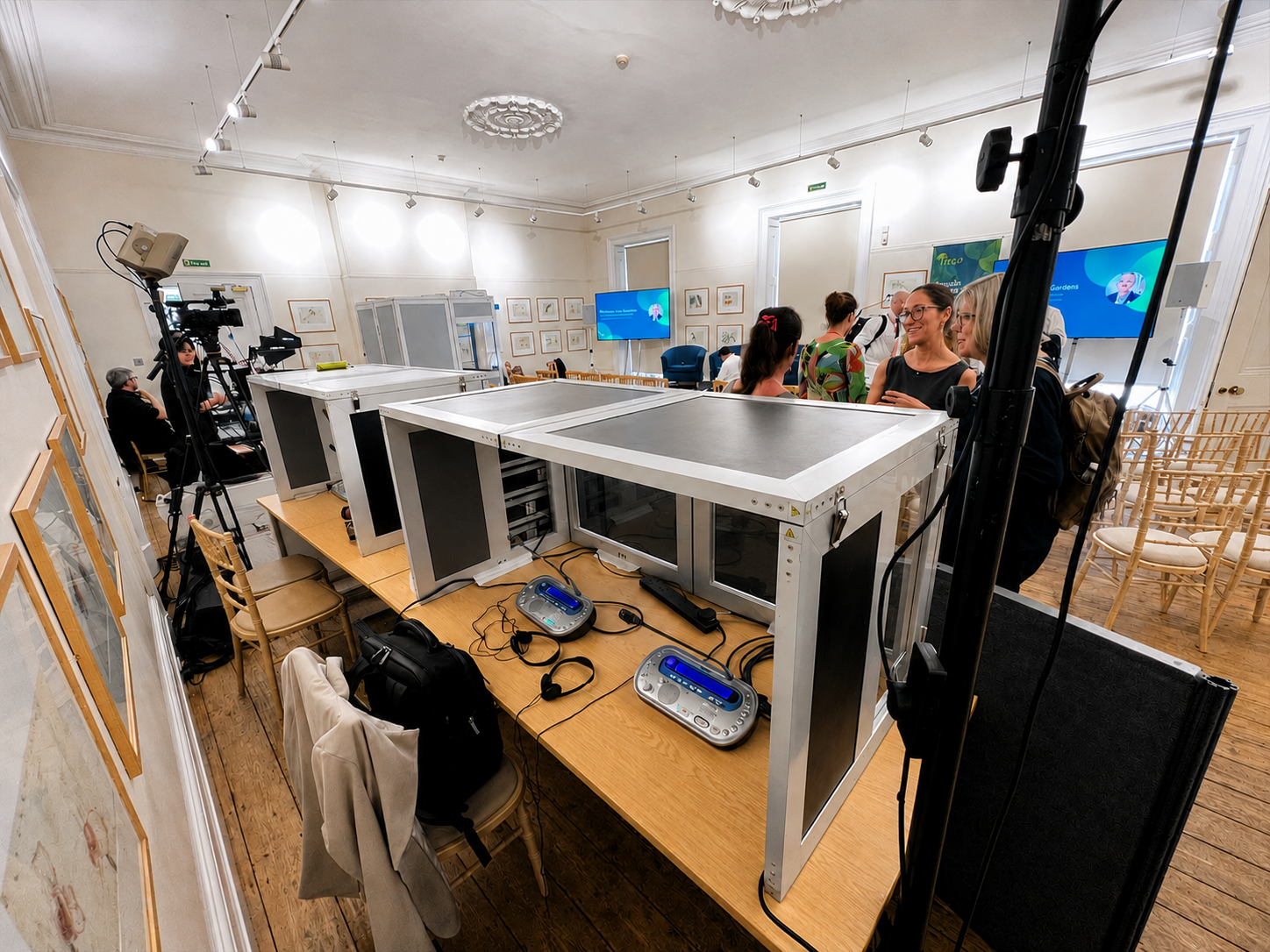
It is tempting to think of simultaneous interpretation as a technical problem: a booth, a console, a set of headsets and a clear signal. The equipment matters, but it is the easy half. The part that actually decides whether your delegates understand the speaker is the interpreter’s mind, and it works far harder than most event organisers realise.
This guide looks beyond the headsets at the human mechanics of simultaneous interpretation: why interpreters work in pairs, why they swap every 20–30 minutes, and why most of their work happens before anyone enters the room.
What does a simultaneous interpreter actually do?
A simultaneous interpreter listens to a speaker in one language and renders it into another in real time, with a delay of only a few seconds and no pauses. Unlike consecutive interpreting, where the speaker pauses for the interpreter, simultaneous interpretation runs continuously as the speaker talks.
To do that, the interpreter performs several demanding tasks at once:
- Listening to and comprehending the incoming speech.
- Analysing meaning, idiom and intent, not just words.
- Formulating an accurate equivalent in the target language.
- Speaking that output clearly, while still listening to what comes next.
- Monitoring their own delivery for errors.
Interpretation scholar Daniel Gile described this through his ‘Effort Models’, which explains the idea that an interpreter is operating at close to maximum cognitive capacity for the entire time they are on the microphone. It is often compared to running a marathon in your head, and the comparison is not far off.
Why do simultaneous interpreters work in pairs?
Simultaneous interpreters work in pairs because the cognitive load is too high for one person to sustain alone without accuracy dropping. Professional standards from AIIC (the International Association of Conference Interpreters) and the ISO 23155 standard require at least two interpreters per language pair for any session of meaningful length; a solo simultaneous interpreter is not considered compliant with professional standards for a full event.
The off-microphone interpreter is not simply resting. While their partner is live, they support actively, noting down numbers, names and dates, looking up unfamiliar terms, and tracking the thread so the handover is seamless. AIIC compares it to the two pilots in an aircraft cockpit: the task demands a level of concentration that needs a second person ready at all times.
Why do interpreters swap every 20 to 30 minutes?
Interpreters rotate roughly every 20 to 30 minutes because research shows interpretation accuracy declines measurably after that point. Sustained simultaneous output keeps concentration and stress at a high level, and once fatigue sets in, errors and omissions rise, exactly when a technical term or a number can least afford to be lost.
The 20–30-minute rotation is the long-established AIIC working standard. This is why a full-day conference needs at least two interpreters per language. It is not one interpreter working through the whole event. Event organisers may see two interpreters per booth as a cost to cut. In reality, it protects accuracy from the first session to the last.
This is where the link between the human and the kit becomes clear. A clean, reliable audio feed reduces strain on the interpreter. A noisy or dropping signal forces them to work harder to fill gaps. Good equipment does not replace the interpreter. It protects their capacity, which is partly why modern interpretation equipment supports clearer international communication.
How much preparation does a simultaneous interpreter do before an event?
Most of a simultaneous interpreter’s work happens before the event, during preparation, and the audience never sees it. Ahead of a job, an interpreter studies the agenda and reviews speaker biographies. They build glossaries of specialist terms. They also work through any slides or technical materials the client provides.
This is why professional interpreters specialise by domain: legal, medical, financial or technical. Conveying terminology accurately needs genuine subject-matter knowledge, not just fluency in two languages. It is also the practical difference between a trained interpreter and a capable bilingual colleague, a distinction worth understanding when you weigh up a bilingual person against a professional interpreter. The more material an organiser shares in advance, the better the result on the day. Preparation is a shared responsibility, not just the interpreter’s.
Why can’t technology replace the human interpreter?
Technology cannot fully replace a human interpreter because machines still struggle with idiom, nuance, cultural context and ambiguity: the parts of language that carry the most meaning. Automated tools are improving and have a real place for simple, low-stakes exchanges, but they do not yet reliably handle a pun, a culturally loaded reference, or a speaker who changes direction mid-sentence.
The realistic future is not human or machine, but a sensible mix: automation for simple cases, skilled humans for anything where accuracy, tone and nuance matter. The wider shift in tools and where they help is covered in how technology is changing the landscape of interpreting services. For high-stakes settings, such as negotiations, legal proceedings and board-level meetings, the human remains the safeguard.
The human factor at a glance
| The practice | Why it exists |
| Two interpreters per language | Cognitive load is too high to sustain solo; AIIC and ISO 23155 require it |
| 20–30 minute rotation | Accuracy declines measurably past this point under sustained load |
| Off-mic partner stays active | Notes numbers, names and terms; ensures a seamless handover |
| Days of preparation | Glossaries, speaker bios and materials studied before the event |
| Domain specialisation | Accurate terminology needs subject knowledge, not just fluency |
Plan for the human factor, not just the hardware
A successful multilingual event plans for the people as carefully as the kit: two interpreters per language, the right specialists for your subject, and materials shared early so they can prepare. Get that right, and the technology fades into the background, which is exactly where it should be. EMS Communications supplies both professional interpreters and tested interpretation equipment for hire across the UK, so the human and technical sides are planned together rather than bolted on. Tell us about your event, and we will plan the interpreters and technical setup around it.
FAQs
How many interpreters do I need for a full-day conference?
At least two per language pair. Simultaneous interpretation requires interpreters to rotate every 20–30 minutes, so a single interpreter cannot cover a full day without accuracy suffering. Sessions lasting approximately 30 minutes or less can sometimes be covered by one interpreter.
Why do simultaneous interpreters only work 20 to 30 minutes at a time?
Because the cognitive demand is extreme, accuracy declines measurably after that point. Rotating with a partner keeps both interpreters fresh and protects quality across the whole event. It is the long-standing AIIC professional standard.
What does the second interpreter do while the first is speaking?
They support actively, writing down numbers, names and difficult terms, looking up terminology, and tracking the discussion so the next handover is seamless. It is teamwork, not downtime.
Is a bilingual colleague as good as a professional interpreter?
Rarely, for live events. Simultaneous interpretation is a trained skill involving real-time analysis under heavy cognitive load, plus domain-specific terminology. Fluency in two languages is the starting point, not the whole job.