
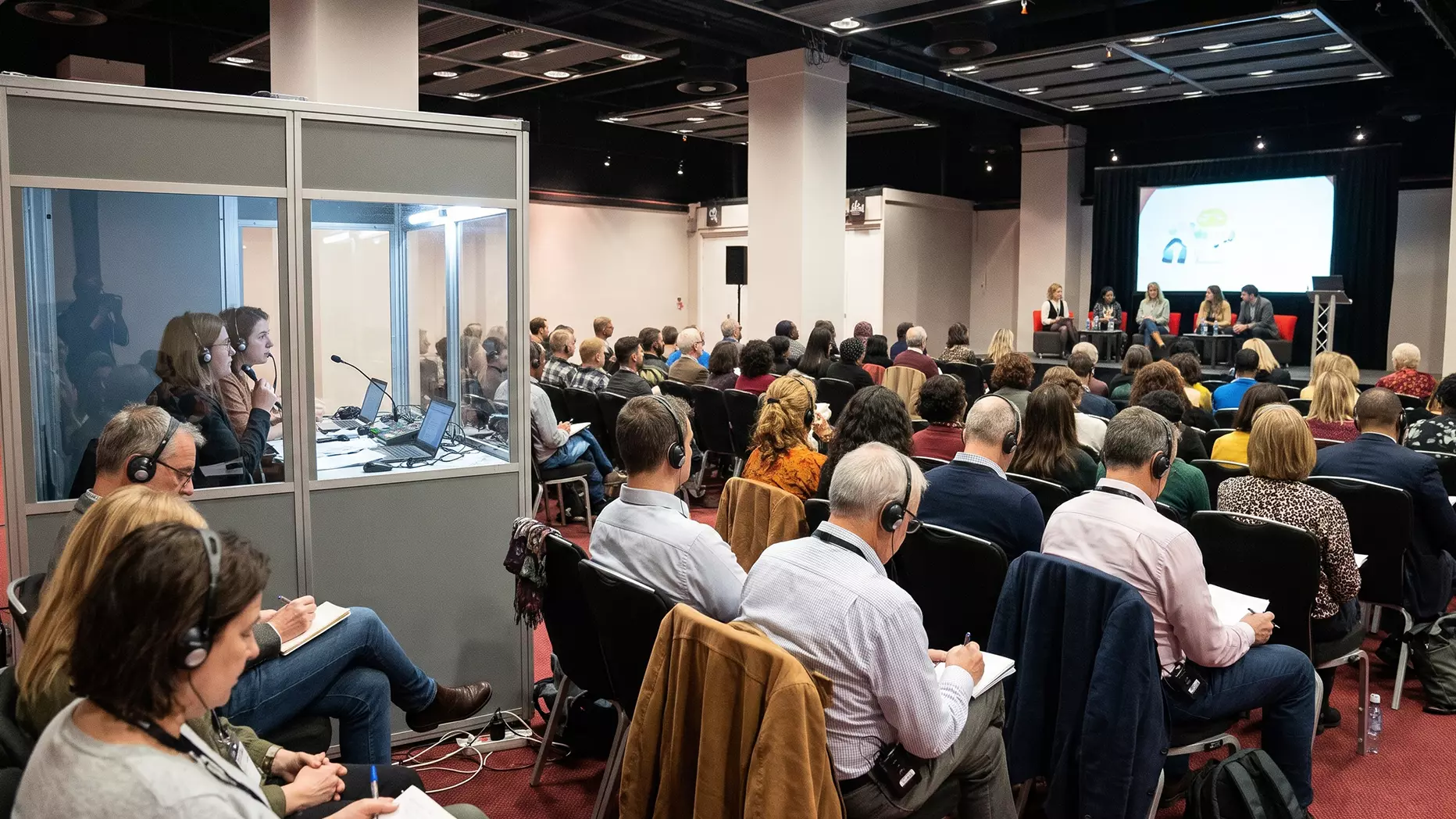
Professional event interpretation services improve audience engagement by helping multilingual audiences listen and respond in real time. Skilled interpreters reduce listening effort and keep delays short. They carry the speaker’s tone and explain technical terms clearly. They also work in pairs, so quality stays steady.
At multilingual UK conferences, interpretation needs to be planned alongside microphones, presentation playback and audience questions. Interpreter preparation and reliable technical delivery help delegates follow the session and take part.
One delegate takes off their headset. Then a few more follow. Side chats begin. Fewer hands go up during the Q&A. The speaker may still be good. The topic may still matter. But some people have stopped following the session because listening has become too much work.
This is where event interpretation services make a real difference. Good interpretation reduces the effort of following a session in another language. Delegates can focus on the speaker’s message rather than translating it in their heads, which makes the session easier to follow.
When that effort drops, people listen for longer. They understand more. They ask better questions. Most of all, they feel like they’re in the same room.
What Does “Professional” Event Interpretation Actually Mean?
Professional event interpretation is live spoken-language support from trained interpreters. It also needs the right equipment, preparation, sound, and working conditions.
It is not the same as asking a bilingual staff member to help. It is not one interpreter covering a full conference alone. It is not an AI-only feed with no human judgement. Interpreting deals with spoken or signed language. Translation deals with written text.
That difference matters. During simultaneous interpreting, the interpreter conveys the message while the speaker continues. They listen, understand the message, and say it in another language almost at the same time.
There are several types of interpretation.
- In simultaneous interpretation, the interpreter speaks while the main speaker continues. This works well for conferences because it keeps the event moving.
- In consecutive interpretation, the speaker pauses, then the interpreter speaks. This suits smaller meetings where the pace can be slower.
- Whispered interpretation, also called chuchotage, works for one or two listeners.
- Relay interpretation uses another language as a bridge when a direct language pair is not possible.
Remote simultaneous interpretation, or RSI, lets interpreters work from another place through a secure platform.
For large events, simultaneous interpreting services are usually the best fit. Delegates hear the message through headsets or a platform while the event keeps its normal pace.
Professional event interpreters also need proper working conditions. AIIC, the International Association of Conference Interpreters, is a key reference for interpreter standards. ITI, the UK Institute of Translation and Interpreting, is also helpful for UK buyers. It lets them check professional quality.
Booth and equipment standards matter too. ISO 17651-1:2024 covers permanent booths. ISO 20109:2025 covers simultaneous interpreting equipment. ISO 24019:2022 covers RSI platforms.
These standards may sound technical, but they affect the audience. If interpreters cannot hear clearly, see the speaker, or work in the right setup, the audience hears the problem through their headsets.
How Interpretation Quality Shapes Audience Engagement
Interpretation quality affects how easy it is for people to listen, understand, and take part. When the sound is clear, the words are right and the delay is short, delegates can focus on the session instead of fighting the language.
| Engagement area | What drives it | What delegates feel |
| Attentiveness | Clear sound and natural voice | They keep the headset on. |
| Comprehension | Correct terms and full meaning | They understand without guessing. |
| Participation | Short delay and clear output | They can ask questions on time. |
| Retention | Steady interpretation | They remember the key points. |
| Satisfaction | Reliable channels and headsets | They feel included. |
This is why multilingual event engagement should be measured by behaviour.
Do not only count how many headsets you ordered. Check how many people used them. Look at Q&A by language group. Watch whether people stay in the room. Read feedback from delegates who used interpretation.
If headset use drops, questions stop, or people leave early, the setup may need review.
Professional interpretation does not guarantee engagement. It removes the language friction that blocks it.
5 Ways Professional Event Interpretation Services Lift Engagement At Multilingual Events
Professional event interpretation services support engagement in five ways: reducing listening effort, limiting delay, preserving tone, improving technical understanding and sustaining quality through interpreter rotation.
1. Cognitive Load: Clear interpretation lets people think, not decode
Listening in a second language can be tiring.
A delegate may understand the words, but still needs extra effort to follow the speaker. They listen, translate in their head, check meaning, watch the slides, and try not to fall behind.
That effort builds over time.
After a while, the person may still look present. In reality, they can appear attentive while missing important details.
Good interpretation lowers that load. It lets people focus on the idea, the numbers, the tone, and the question they want to ask.
A 2025 PLOS One study compared automatic subtitles, simultaneous interpreting and a combination of both. The combined format produced the lowest cognitive effort and stress among the 45 participants. Comprehension scores did not differ significantly between groups. These findings support considering interpreting and subtitles together when planning audience language support.
2. Latency: Short Delay Keeps Delegates In The Live Conversation
Latency means the delay between the speaker and the interpreted audio.
A small delay is normal. The interpreter needs a moment to understand the speaker before giving the message in another language.
Problems start when the delay grows.
The English-speaking audience laughs first. People using interpretation hear the line later. The chair moves on. A speaker may start answering before the listener fully receives the interpreted question.
That gap makes people feel outside the live moment.
Clean audio helps keep delay under control. Interpreters need a clear feed from microphones, video playback, and the sound desk. Poor sound, echo, weak microphones, or bad routing all make the work harder.
RSI has improved a lot, but the delay has not disappeared. A strong RSI setup can get close to an on-site experience, but it does not fully replace it in every setting.
3. Voice And Tone Fidelity: Flat Delivery Loses The Room
Professional interpretation is more than swapping words.
A skilled interpreter carries the speaker’s meaning, pace, tone, and intent. That matters because people respond to voice, not only to facts. A warm speaker should not sound cold through the headset. A serious point should not sound casual. A precise answer should not sound vague.
Flat delivery can lose the room, even when the words are correct.
This is one reason human interpreters still matter at high-stakes events. When assessing AI tools, test how they handle tone, idioms, specialist terms and live corrections. Review confidentiality and data handling separately.
4. Subject-Matter Preparation: Briefed Interpreters Protect Comprehension
Briefed interpreters do better work because they know what is coming.
They need slides, agendas, speaker names, scripts, acronyms, product names, and key terms. For technical sessions, a short preparation call can prevent many problems.
Without preparation, the risk goes up. Product names may be misheard. Acronyms may be misunderstood. Technical terms may be rendered inconsistently. Important distinctions may be lost.
That makes delegates unsure. Once people start doubting the message, they stop engaging with confidence.
Preparation isn’t a pleasant add-on. It’s essential to quality.
Good interpretation depends on the interpreter’s skill, the speaker’s discipline, and the technical setup.
5. Pair-Working: Two Interpreters Sustain Quality Across Long Sessions
Simultaneous interpreting is demanding work.
The interpreter listens, understands, speaks, checks their own output, follows the slides, and prepares for the next sentence. All of this happens at once.
That is why interpreters usually work in pairs at conferences. AIIC guidance notes that interpreters often work in teams of at least two and take turns every 20 to 30 minutes.
This keeps quality steady throughout the day. While one interpreter speaks, the other can help with names, figures, terms, slide references, and quick checks. Then they switch.
One interpreter alone may sound fine at the start. Later, tiredness can show up as slower delivery, missed details, weaker tone, or more mistakes.
The audience hears that drop before the organiser sees it. Equipment matters too. Bosch Integrus interpretation equipment gives delegates clear access when channels, receivers, headsets, and support are planned properly.
How To Brief Interpretation To Maximise Engagement
To maximise engagement, brief interpretation as part of audience access, not as a late supplier task. The brief should cover language demand, session format, interpreter team strength, source audio, preparation material, equipment, RSI testing, and delegate instructions before the event goes live.
- Collect Language Needs At Registration
Ask delegates which spoken language they prefer for listening. Do not infer language needs from nationality alone. This helps you choose the right languages, booth teams, headsets, and RSI channels.
- Choose The Right Format For Each Room
Use simultaneous interpretation for large conferences where pace matters. Use consecutive interpretation for smaller meetings. Use whispered interpretation for one or two people. Use a relay only when a direct language pair is not possible.
- Share Materials Early
Send slides, scripts, agendas, speaker names, bios, product terms, and glossaries. Agree on a secure way to share confidential materials with the interpreting team, using an NDA where appropriate.
- Confirm interpreter team strength
Ask how many interpreters will cover each language. For long or technical sessions, make sure pair-working and rotation are included.
- Test The Full Technical Chain
For on-site events, test microphones, playback, booth feed, channel labels, headsets, and spare receivers. For RSI, test the speaker microphone, interpreter feed, return audio, platform channels, internet stability, and backup route.
- Plan delegate support and feedback
Make language instructions clear at registration, in the app, and in the room. Then track headset use, channel selection, Q&A by language group, session retention, and feedback. For larger events, audit your conference interpretation setup audit can catch problems before delegates notice them. If the event is complex, read why an interpretation technician matters.
Signs Your Interpretation Setup Is Hurting Engagement
Changes in headset use, participation and delegate feedback are reasons to review the interpretation setup. Check the audio, terminology and channel instructions before drawing conclusions. Watch the interpreted audience, not just the main stage. Headset use, Q&A behaviour, side conversations, channel switching, and feedback often reveal problems before formal complaints arrive.
- Headset usage drops sharply after the first session and never recovers.
- Non-English-speaking delegates ask fewer questions than English-speaking delegates.
- Delegates keep removing one earcup to compare the room audio with the interpreted feed.
- Side conversations increase during interpreted panels or technical sessions.
- Feedback praises the speaker but rates the session experience poorly.
Possible causes include unclear audio, excessive delay, inconsistent terminology, unclear channel instructions, interpreter fatigue, or an unsuitable interpretation mode.
Next Step
Professional event interpretation does not create engagement from weak content. It removes the language friction that stops people from engaging with good content. That is where the improvement shows up. People keep listening. They understand the details. They react in time. They ask better questions. They leave with the same message as everyone else in the room.
Planning a multilingual conference in London? Contact EMS Communications to discuss interpreters, equipment and technical support for your audience.
FAQs
What Is Professional Event Interpretation?
Professional event interpretation is live spoken-language support from trained interpreters. It uses proper preparation, equipment, and working conditions. It can include simultaneous, consecutive, whispered, relay, and RSI interpretation. It is not a written translation, untrained bilingual help, or an AI-only feed used without professional review.
How Does Simultaneous Interpretation Improve Audience Engagement At Conferences?
Simultaneous interpretation helps delegates follow the speaker almost in real time. When the output is clear, accurate, and close to the live pace, delegates keep listening. They understand technical points, react with the room, and feel confident enough to ask questions.
Why Do Conference Interpreters Work In Pairs?
Conference interpreters work in pairs because simultaneous interpreting takes intense focus. Rotation protects accuracy, pace, tone, and completeness across long sessions. The interpreter who is not speaking can also help with names, figures, terms, and slide references.
Can AI Interpretation Replace Human Interpreters At Corporate Events?
Assess AI interpretation against the event’s language combinations, specialist terminology, confidentiality requirements and need for live interaction. The issue is not only accuracy. Privacy, tone, specialist terms, data handling, and live correction all need professional judgement.
What Is The Difference Between On-Site And Remote Simultaneous Interpretation?
On-site simultaneous interpretation places interpreters at the venue, usually in booths, with clear sightlines and controlled audio. Remote simultaneous interpretation uses a platform while interpreters work elsewhere. RSI can work well, but it needs strong audio, platform testing, rehearsal, and backup planning.